AI-Powered Skill Assessment
Test your skills & get your job readiness score
Not sure where you stand in today's job market? Our AI-powered skill assessment helps professionals and students test their skills, find out how job-ready they are, and get a clear report - covering your strengths, skill gaps, roles to target, and what to focus on next.

Skill Proficiency

Karan Ahuja
Backend Developer
Job Readiness Score
Improve Python & Consistency to reach top 10% in your role.
Skills Verified by Talent from




Why Take a Skill Assessment to Improve Your Skills?
In today's job market, understanding how good you are at something isn't just a nice-to-have; it's what sets you apart from the others. This is why thousands of people take our tests every week.

Evaluate Your Skills
Get proof of your skills that employers can trust, validated by AI, that goes beyond a simple resume listing.

Speed Up Your Career Growth
Find out exactly what skills you need to improve and get a personalised plan to get you from where you are to where you want to be.

Skill Testing That Matters
Domain specialists carefully choose each question and update them to match the skills needed for jobs in your sector.

Make Yourself Stand Out to Employers
A verified Job Readiness Score provides you an edge over other candidates since recruiters love individuals who can measure their talents.

Compare Yourself to Others
Find out exactly where you stand among thousands of professionals in your field.

Build Lasting Confidence
Knowing where you really stand gets rid of imposter feeling and gives you the confidence to go after greater chances.

Ready to discover your true skill level?
Join 50,000+ professionals who've taken the assessment. Free, instant, and insightful.
How Our AI Skill Assessment Works
From picking your role to receiving your full report, the whole thing takes around 30 minutes.

Pick the Role That Fits You
Choose from over 50+ career roles for targeted skill testing - Data Scientist, Cloud Engineer, AI Specialist, and many more. The system tailors every question to match the path you're on.
- Over 50 roles to choose from
- Skill areas matched to your field
- Difficulty adjusts as you go

Take the Assessment
Spend about 30 minutes answering AI-adaptive questions designed to assess skills. The system adjusts difficulty in real time based on your answers to accurately gauge where you stand.
- Adaptive AI questions
- ~30 minutes duration
- No time pressure

Get Instant AI Report
Get your full report right away when you finish. It will include your Job Readiness Score, a description of your skills, a comparison with your peers, and a personalised strategy for how to get better.
- Instant report delivery
- Job Readiness Score
- Improvement roadmap

AI-Powered Skill Assessment for a Correct Evaluation
You get a score on a regular test. Our AI shows you a mirror that honestly and in many ways shows how your skills would work in the actual world.
AI-Powered Evaluation Engine
Our own AI engine looks at more than simply whether answers are correct. It also looks at how you think, how you respond, and how well you comprehend the material, giving you a multi-dimensional skill profile.
Technology for Adaptive Testing
Every question changes based on how well you're doing in real time. The questions get harder if you get them right, and the system resets if you don't. This takes away the guessing and tells you exactly what your level is.
Algorithm for Smart Scoring
In addition to pass/fail, our clever scoring looks at speed, accuracy, consistency, and conceptual depth to give you a score that shows how well you really did at work.
Mapping Skills in Many Directions
Your report shows exactly where you thrive and what you need to work on next by mapping your skills across three levels of competency: fundamental, intermediate, and advanced.
Measure Your Job Readiness Score
Your Job Readiness Score is the single most important number in your career toolkit — a 0-100 metric generated through a smart career assessment that tells you and employers exactly how prepared you are to land your next role.
Join the Waitlist


Job Readiness Score

Ruchi Saraf
Senior UX Designer
How It's Calculated
Why Your Job Readiness Score is Important
Recruiters Trust It
Hiring managers can tell right away how ready you are for a job without having to do long technical interviews.
Track Your Growth
Retake assessments and watch your score climb as you learn. A tangible measure of career progress.
Know Your Target
Different roles require different scores. Know exactly what score your dream job demands.
Role-Based Skill Assessments for In-Demand Careers
Every assessment is built for your specific role — not a generic test. Questions, benchmarks, and reports are tailored to what hiring managers in each field actually look for.


Skills You Can Test and Validate
From foundational programming to cutting-edge AI — validate any skill you need to advance your career.


Get a Detailed Skill Assessment Report
When you finish, you get more than a score. You get a report that breaks down exactly what you're good at, where you're falling short, and what to focus on next.
Join the Waitlist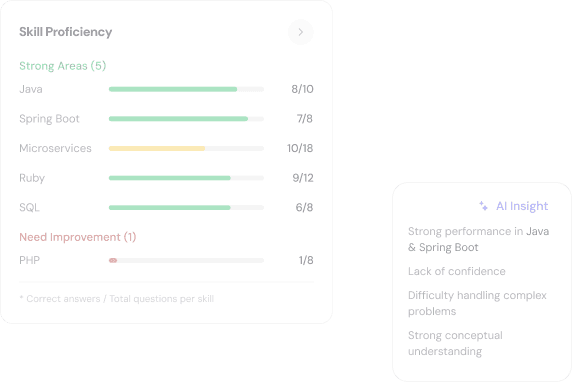

Samuel Specer
Software Engineer@Wipro Mumbai
Job Readiness
Hiring Probability
Overall Activity
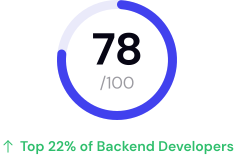
Job Readiness Score
A real benchmark based on what employers in your field look for. If you're ready, you'll know. If not, you'll know exactly why.
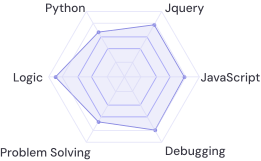
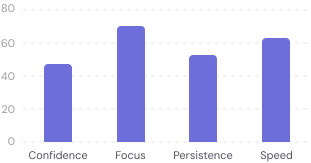
Skill Strength Breakdown
A clear breakdown of where you stand across every competency in your role. No averages hiding your weak spots — just the full, honest picture.
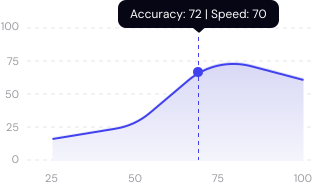
Speed & Accuracy Insights
Find out if you're rushing and slipping up, or pacing yourself and getting it right. In real work, both your speed and your accuracy tell a story.
Behavioural Analysis
A plain-English profile of how you collaborate, handle pressure, and make decisions. No labels, no jargon — just an honest look at how you work.
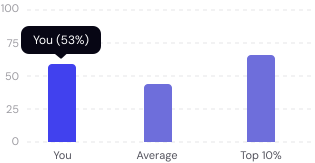
Market Comparison
See where you rank among professionals at the same stage and in the same role. It puts your score in context — and gives you something real to aim for.
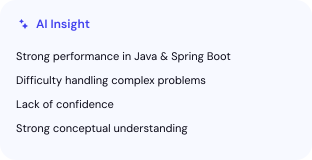
Improvement Plan
Based on your gaps and goals, we lay out what to focus on first and what to learn next. Short, specific, and actually doable.
Get Personalized Insights to Improve Your Skills

Strong Areas (5)
Need Improvement (1)
Improve Python & Consistency to reach top 10% in your role.
Advantages of Testing Your Skills Online
Skill assessment gives you obvious, measurable value at every level of your career, whether you're just starting out or have been doing it for a long time. Test your skills online and see exactly where you stand.

Student
Getting Ready to Enter the Job Market
- Before you graduate, make sure that you're prepared for your profession.
- Find out whatever technical gaps you need to fill while you study.
- Make a real talents profile for your first interview.
- Get a real plan to make your resume stand out.

Professionals
Looking to grow or Transition
- Track skills you obtain from experience
- Find the gaps that will help you get your next promotion or job.
- Compare yourself to pros at the senior level
- Confirm your skills for freelance or consulting work

Job Seekers
Actively looking for Opportunities
- Get a Job Readiness Score to show to recruiters
- Be sure of the roles you are ready for right now
- Reduce your interview stress with objective self-knowledge
- Speed up the shortlisting process with a certified skill badge

Score Distribution

Score Distribution

0100
Compare Your Skills with Industry Benchmarks
Stop guessing where you stand. Our benchmarking engine gives you a precise, honest view of your position in the talent landscape.
Peer-to-Peer Comparison
Compare your skills with peers in the same role and experience—fair, relevant, and honest.
Industry Standards
See how you match industry expectations—meet the bar or exceed it.
Ranking Insights
Learn your percentile, how far you are from the next level, and what skills the best performers have.
Why Choose SkillMX for Skill Assessment
Other platforms test you. SkillMX prepares you. Here's what makes us categorically different.
Genuine AI Advantage
Our AI engine doesn't just grade multiple choice — it analyzes reasoning, pattern recognition, and conceptual depth. The result is a far more accurate picture than any static test.
Role-Based Precision
Every assessment is built ground-up for a specific role by domain experts. A Data Scientist test tests actual data science — not watered-down generic programming questions.
Actionable, Not Just Informational
We tell you what to do next. Every report includes a prioritized 30-day improvement plan with resources, timelines, and projected score improvements.
Built for Busy Professionals
~30 minutes. No scheduling, no proctoring setup, no waiting. Take your assessment whenever you have a free slot — mobile, desktop, anywhere.
Trusted Scoring You Can Share
Our verified digital credential includes a QR code for recruiter verification. Share your score on LinkedIn, your resume, or directly with hiring managers.
Instant, No Barriers
No sign-up required to start. No payment upfront. Get your full report for free. We believe access to career clarity should have zero friction.
Frequently
Asked Questions

Start Your Skill Assessment Today
Your next move starts with knowing exactly where you stand right now.