
What Happened
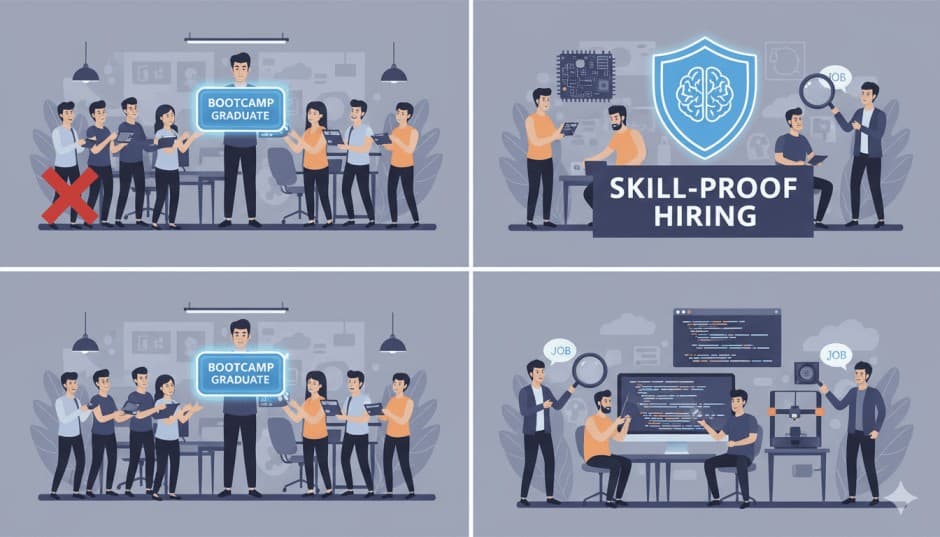
Technology employers across the United States, Europe and India have begun changing how they evaluate entry-level candidates, reducing reliance on coding bootcamp certificates and prioritizing practical proof of ability. Since late 2025 and accelerating into early 2026, hiring teams at software companies and startups have adopted structured skill-verification methods, including coding assessments, project repositories and task-based interviews.
Recruitment teams at multiple mid-size software firms confirmed they now require candidates to complete real work simulations rather than relying on resumes or educational credentials. Hiring managers are increasingly asking applicants to submit GitHub repositories, completed projects, or participate in live coding workflows designed to replicate real job conditions.
The shift has affected two groups simultaneously: coding bootcamp graduates, who once relied on short-term programs to access tech careers, and self-taught developers using online platforms, open-source projects and AI tools to learn independently.
The change comes during a broader correction in the technology labor market following layoffs across large technology firms during 2023 and 2024 and the rapid introduction of AI-assisted programming tools.
Background
For nearly a decade, coding bootcamps positioned themselves as an alternative pathway into software engineering careers. Short programs ranging from 10 to 24 weeks promised rapid job placement, often advertising hiring rates above 70% during peak hiring years between 2018 and 2021.
Those models depended on a specific hiring environment: strong venture funding, aggressive startup expansion, and a shortage of junior developers.
That environment changed.
Technology companies slowed hiring in 2023 amid rising interest rates and lower venture investment. Entry-level hiring declined first, while companies retained senior engineers and automation systems. The introduction of generative AI coding assistants in 2023 and 2024 further altered expectations of junior roles.
Companies discovered that simple programming tasks — historically assigned to entry-level developers — could now be partially automated. Employers began restructuring junior positions into fewer, higher-skill roles requiring stronger debugging, system thinking, and collaboration abilities.
As a result, employers began focusing less on educational pathways and more on demonstrated capability.
Why Hiring Criteria Changed
Recruiters say three developments pushed the transition: AI programming tools, remote hiring, and verification needs.
First, AI coding assistants now handle syntax, boilerplate code and debugging suggestions. This reduced the value of purely instructional training and increased the importance of understanding architecture, logic and problem-solving.
Second, remote hiring expanded the talent pool globally. Companies now receive applications from multiple countries for the same role, making credential-based filtering less useful.
Third, companies experienced mismatches between credentials and job readiness. Hiring teams reported candidates with certificates but limited ability to complete real tasks, while some self-taught developers demonstrated stronger production-ready skills.
Industry Reaction
Bootcamp providers have begun adapting their programs. Several training organizations have expanded internship partnerships and project-based curricula, replacing lecture-heavy instruction with supervised production environments.
Some programs now require students to ship working applications, collaborate in teams, and maintain public code repositories before graduation. Others have introduced employer-verified assessment reports rather than completion certificates.
Meanwhile, online learning platforms have seen growth in project-based courses. Self-learning pathways now commonly include building full applications, contributing to open-source software, and documenting development workflows publicly.
Employers also appear to be formalizing the change. Several companies now use structured hiring pipelines combining automated technical assessments, real-world tasks and behavioral collaboration interviews.
Market Impact
The hiring shift is affecting the education and recruitment markets simultaneously.
Bootcamp enrollment growth has slowed compared with pre-2022 levels. Placement timelines for graduates have lengthened, particularly for generalist web development roles. At the same time, platforms hosting coding repositories and technical portfolios report increased usage from job seekers preparing public work samples.
Recruitment technology companies are expanding assessment-based hiring products, including coding challenges, role simulations and take-home assignments.
The trend aligns with a broader workforce development movement in which employers prioritize “skills-based hiring” over degree-based hiring — a change also visible in non-technical roles such as data analysis and cybersecurity.
User Impact
For job seekers, the shift changes how candidates prepare for technology careers.
Candidates now spend more time building demonstrable projects than completing coursework. Hiring managers increasingly evaluate:
- shipped applications
- real debugging capability
- collaboration practices
- code readability and documentation
The resume itself has become less central. Recruiters often review candidate repositories and practical assignments before interviews.
Bootcamp graduates are not excluded from hiring, but their certificate alone no longer serves as proof of readiness. Instead, graduates must demonstrate production-level skills similar to self-taught developers.
Competitive Pressure
Competition for junior roles has intensified due to global hiring and remote work adoption. Companies can evaluate candidates across multiple time zones, increasing applicant volume and forcing more rigorous screening.
Simultaneously, AI-assisted development tools have raised the expected baseline capability. Employers now expect entry-level developers to understand systems, testing, and debugging rather than only writing code.
This has narrowed the gap between formal and informal education pathways, effectively placing both bootcamp graduates and self-learners into the same evaluation framework.
Why This Matters
The change affects workforce pipelines into the technology industry. Bootcamps previously functioned as a rapid reskilling channel for career changers. With hiring standards shifting toward demonstrable ability, training providers must integrate real-world work environments into education.
It also affects companies. Structured assessments aim to reduce hiring mistakes and training costs, particularly as software teams become smaller and more productivity-focused.
Finally, it influences the broader labor market. Governments and workforce programs have relied on accelerated training pathways to address tech skill shortages. The new hiring model suggests employers are not eliminating entry-level roles, but redefining them into skill-verified positions.
What Comes Next
Recruiters expect assessment-based hiring to expand across technical roles beyond software engineering, including data analytics, cybersecurity and AI operations. Training organizations are already forming partnerships with companies to integrate real production work into curricula.
Companies are also experimenting with probationary project contracts in place of traditional interviews. Instead of evaluating candidates through questions alone, employers may hire applicants into short paid project periods before offering full-time roles.
The next phase will likely involve standardized skill verification systems and interoperable hiring assessments, potentially reshaping how candidates enter the technology workforce globally.