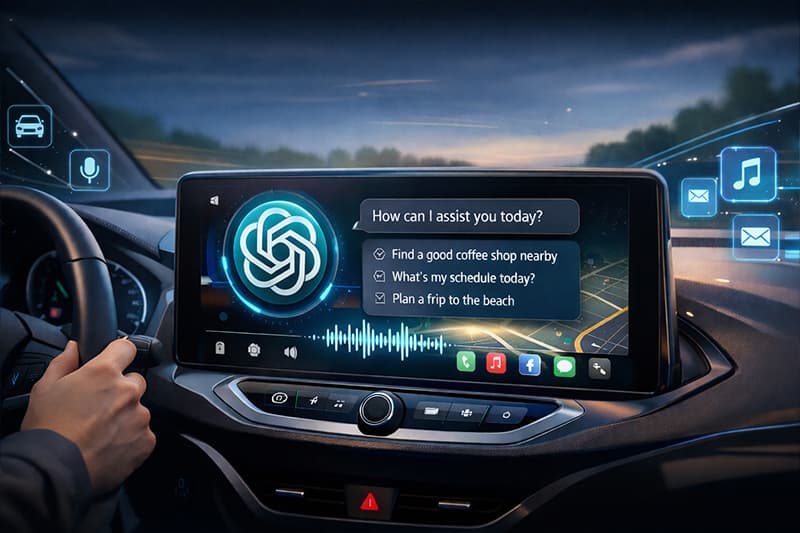

Apple is working to make its CarPlay platform compatible with AI chatbots similar to ChatGPT, signaling a major leap in in-car intelligence. The initiative aims to integrate advanced conversational AI into vehicle dashboards, enabling more natural voice interactions. The development reflects Apple’s broader push into generative AI and could reshape how drivers access information, navigation, and entertainment hands-free.
Background
CarPlay has evolved significantly since its launch, transforming from a simple iPhone mirroring system into a deeply embedded in-car operating layer. Recent updates expanded support for vehicle controls, instrument clusters, and real-time diagnostics.
At the same time, the automotive industry has been rapidly adopting AI-driven voice assistants. Automakers and tech firms alike are racing to embed generative AI into vehicles, aiming to reduce driver distraction while enhancing personalization. Apple’s move aligns with this wider trend of software-defined vehicles powered by cloud intelligence.
Key Developments
According to industry insiders familiar with the project, Apple is developing frameworks that would allow CarPlay to interface with external AI chatbot systems, including large language models.
Executives involved in the initiative say the goal is to enable richer, context-aware conversations inside the car. Instead of issuing rigid commands, drivers could ask complex, multi-step questions such as planning trips, summarizing messages, or getting real-time recommendations.
The integration is also expected to work alongside Siri, potentially augmenting Apple’s native assistant rather than replacing it. Early prototypes reportedly focus on messaging, navigation queries, and productivity use cases.
Technical Explanation
Traditional in-car voice systems rely on rule-based commands — for example, “Call John” or “Play jazz.” AI chatbots powered by large language models interpret natural speech more fluidly.
Think of it as the difference between using a remote control and talking to a human co-driver. A chatbot-enabled CarPlay could understand nuanced prompts like:
- “Find a quiet café on my route with parking.”
- “Summarize my last three work emails.”
- “Explain this news headline in simple terms.”
Processing would likely combine on-device intelligence with cloud computing to balance speed, privacy, and capability.
Implications
For drivers:
More intuitive, hands-free interactions could reduce distraction and improve safety while adding convenience.
For automakers:
Deeper AI integration may increase reliance on Apple’s software ecosystem, influencing dashboard design and data partnerships.
For Apple:
The move strengthens its position in the generative AI race, embedding its services into another daily environment — the car.
For developers:
New APIs could open opportunities for AI-powered automotive apps spanning travel, commerce, and media.
Challenges
Despite the promise, several hurdles remain:
- Privacy concerns: Vehicles generate sensitive location and behavioral data.
- Latency risks: Cloud-based AI must respond instantly to avoid driver frustration.
- Automaker control: Some manufacturers resist deeper platform dependence.
- Safety regulation: Conversational AI must meet strict driver-distraction standards.
There’s also the technical challenge of ensuring AI responses remain accurate in high-stakes driving contexts.
Future Outlook
Apple is expected to preview expanded AI capabilities across its ecosystem, and CarPlay could be a centerpiece of that strategy. Future iterations may include:
- Predictive trip planning
- AI-generated vehicle diagnostics explanations
- Personalized infotainment curation
- Multimodal interfaces combining voice and visual AI
As vehicles become smarter, conversational interfaces may replace traditional touchscreen navigation altogether.
Conclusion
Apple’s exploration of AI chatbot compatibility in CarPlay marks a pivotal step toward conversational vehicles. By blending generative AI with automotive interfaces, the company aims to make driving more intuitive, productive, and personalized. If executed well, the dashboard could become the next major frontier for everyday AI interaction.