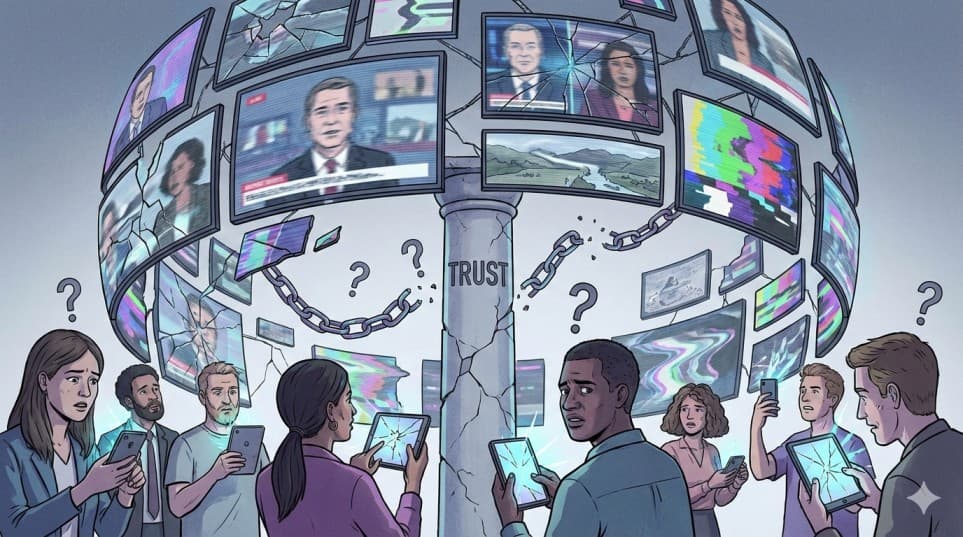

AI-generated fake images and videos are no longer niche experiments—they are now shaping public perception during elections, conflicts, and breaking news events. From viral deepfake clips of political leaders to fabricated war visuals circulating on social media, governments worldwide are struggling to keep pace. In India, policymakers and regulators are increasingly treating synthetic media not just as a tech issue, but as a national trust and security challenge.
Background: From Creative Tool to Information Weapon
Generative AI tools were initially celebrated for creativity and productivity. But over the past year, the same tools have been used to create realistic images, videos, and audio that are difficult for the public to distinguish from reality. Unlike traditional misinformation, AI-generated content scales instantly, looks convincing, and spreads faster than fact-checking systems can respond.
This shift has turned “seeing is believing” into a liability.
Key Developments: Why Governments Are Alarmed
Recent global incidents—ranging from fake arrest videos of political leaders to AI-generated visuals during military conflicts—have highlighted how synthetic media can distort reality within minutes.
Indian officials have privately acknowledged that existing IT and media laws were not designed for:
- Real-time AI video impersonation
- Election-period deepfakes
- Crisis misinformation amplified by algorithms
The concern is not hypothetical. During high-tension moments such as elections or civil unrest, even a short-lived fake video can trigger panic, violence, or diplomatic fallout.
Case Study Lens: Elections, Riots, and Conflicts
During election cycles, AI-generated speeches or visuals of candidates can circulate before authorities or platforms intervene. In conflict situations, fabricated images can inflame public sentiment or misrepresent ground realities. In riot-like scenarios, fake visuals can escalate fear and retaliation.
Security analysts warn that the speed of AI misinformation, not just its accuracy, is what makes it dangerous.
Technical Explanation: Why AI Fakes Are Hard to Stop
Modern AI models can generate:
- High-resolution faces and voices
- Realistic lighting and motion
- Context-aware scenes
Unlike older manipulated media, these outputs leave few obvious traces. Detection tools exist, but they are often slower than viral spread. Once content is shared across messaging apps and platforms, rollback becomes nearly impossible.
What the Indian Government Is Considering
India’s emerging approach focuses on risk-based regulation, not blanket bans. Policymakers are discussing:
- Mandatory labeling of AI-generated political content
- Faster takedown mechanisms during elections and emergencies
- Stronger platform accountability for repeated failures
Officials are also emphasizing public awareness, treating media literacy as a digital defense rather than an educational add-on.
Platform Accountability: The Pressure Is Rising
Governments argue that AI platforms and social networks cannot remain neutral hosts when their tools enable mass deception. Expectations from platforms are growing:
- Default watermarking for AI-generated content
- Rapid response teams for verified deepfakes
- Transparency reports on synthetic media abuse
The message from regulators is clear: innovation cannot come without responsibility.
Challenges and Criticism
Critics warn that overregulation could stifle creativity or be misused to censor legitimate expression. Others point out that watermarking and detection are not foolproof and can be bypassed.
Still, policymakers counter that inaction carries a higher risk—the erosion of public trust in information itself.
Future Outlook: A Race Against Time
Experts believe the next phase will not be about stopping AI-generated content, but managing its impact. Expect:
- Election-specific AI rules
- Government–platform coordination cells
- Public verification tools for journalists and citizens
The long-term challenge is rebuilding trust in a world where reality can be synthesized on demand.
Conclusion
AI has made creating believable falsehoods easier than ever. The real test for governments and platforms is not technological—but institutional. In the age of synthetic media, protecting truth may become as important as protecting data.