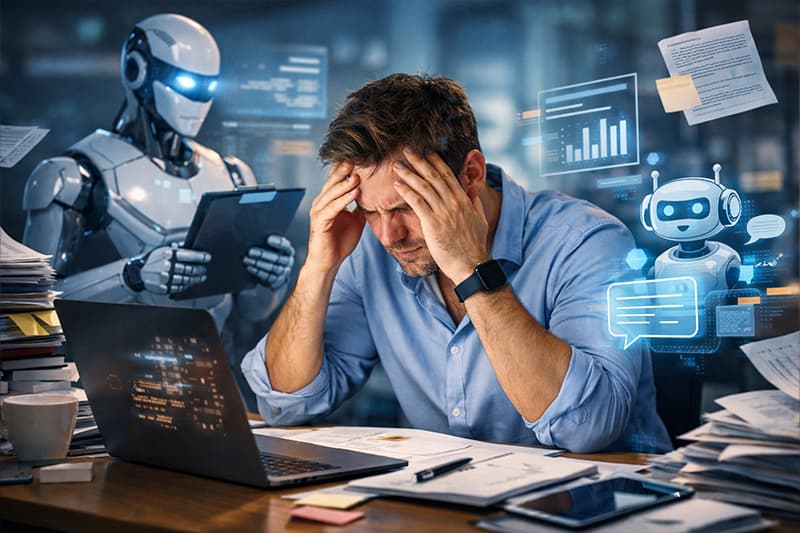

The first wave of burnout tied to artificial intelligence is surfacing—not among skeptics, but among its most enthusiastic adopters. Knowledge workers who rapidly integrated generative AI into daily workflows are reporting fatigue, cognitive overload, and longer working hours. The trend, observed across tech, marketing, consulting, and software sectors through 2025–2026 workforce studies, raises questions about AI’s human cost even as productivity climbs.
Background
Since the mainstream rise of generative AI tools, organizations have encouraged employees to embed AI into writing, coding, research, design, and decision-making. Early productivity data showed measurable efficiency gains, with some firms reporting task completion speeds improving by 20–40%.
This acceleration created a new class of “AI power users”—employees who not only adopted AI early but became internal champions, trainers, and workflow architects. Over time, however, researchers and workplace psychologists began tracking an unintended side effect: sustained mental strain tied to always-on augmentation.
Key Developments
Recent workforce behavior analyses and enterprise productivity surveys reveal a pattern:
- Heavy AI users are working longer effective hours, not fewer.
- Employees report pressure to produce more output because AI makes speed possible.
- Managers increasingly benchmark performance assuming AI assistance.
- “Prompt optimization” and output verification add invisible labor.
Organizational psychologists studying digital work patterns note that AI has shifted effort rather than eliminated it. One workplace researcher explained that while AI reduces mechanical workload, it increases supervisory cognitive work—reviewing, editing, validating, and contextualizing outputs.
In internal enterprise pilots, some teams saw productivity gains plateau after initial spikes, coinciding with reported fatigue and disengagement among top AI adopters.
Technical Explanation
Burnout among AI power users stems from three overlapping dynamics:
1. Cognitive Load Expansion
Instead of doing one task, workers now manage multiple layers—prompt design, output evaluation, fact-checking, and iteration.
2. Decision Fatigue
AI produces numerous options quickly. Choosing, refining, and aligning them with business goals increases mental strain.
3. Productivity Inflation
When output becomes easier to generate, expectations rise. Workers feel compelled to deliver more volume, faster turnaround, and higher polish.
An analogy often used by workplace experts: AI acts less like an autopilot and more like a hyper-efficient intern—fast but requiring constant supervision.
Implications
The emergence of AI-linked burnout has wide implications:
- For employees: Blurred work boundaries and “always-augmenting” pressure.
- For employers: Risk of overestimating sustainable productivity gains.
- For HR leaders: Need to redefine performance metrics in AI-enabled roles.
- For society: A cultural shift in how cognitive labor is valued and measured.
If unmanaged, experts warn of a paradox where tools designed to reduce effort end up intensifying psychological workload.
Challenges
Despite early signals, measuring AI burnout remains complex.
- Many studies rely on self-reported fatigue metrics.
- Productivity gains still outweigh strain in short-term data.
- AI literacy gaps mean not all workers experience the same pressure.
- Some burnout may stem from broader digital overload, not AI alone.
There is also a cultural factor: high performers are more likely to overuse productivity tools, making causation harder to isolate.
Future Outlook
Organizations are beginning to respond with structural safeguards:
- AI usage guidelines and “augmentation caps”
- Training on realistic productivity expectations
- Mandatory human review time buffers
- Well-being policies addressing cognitive fatigue
Researchers are also exploring “human-centered AI workflows” designed to optimize not just output—but mental sustainability.
As AI agents become more autonomous, the supervision burden may decrease. However, new governance and trust responsibilities could replace it.
Conclusion
The first signs of AI burnout signal a maturing phase of workplace automation. Productivity gains remain real—but so do human limits. As enterprises scale AI adoption, balancing augmentation with well-being will determine whether AI becomes a long-term performance multiplier or a silent driver of workforce fatigue.