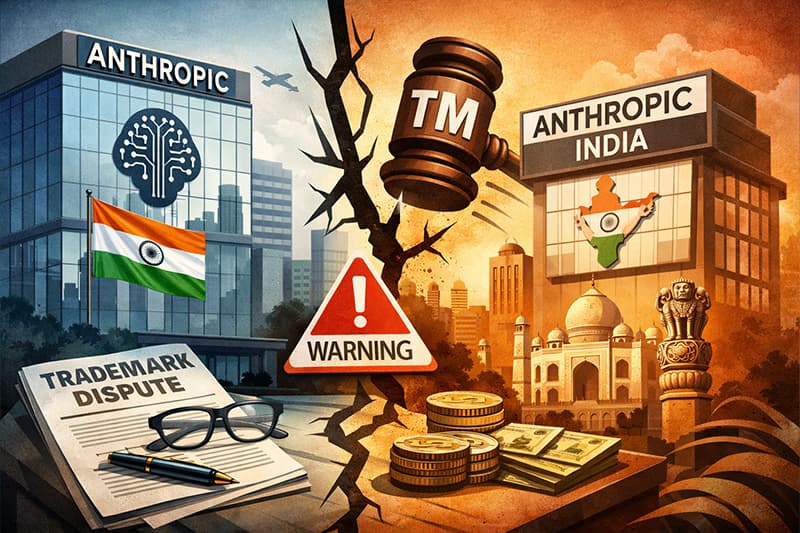

Anthropic’s push into India has run into an unexpected hurdle: a naming conflict with a local company already operating under the “Anthropic” brand. The clash emerged as the U.S.-based AI firm moved to formalize its presence in one of the world’s fastest-growing AI markets. The dispute underscores how global AI expansion is increasingly colliding with local intellectual property realities. For Anthropic, the outcome could shape branding, legal strategy, and speed to market in India.
Background
Anthropic, best known for its Claude family of AI models, has been accelerating international growth amid surging enterprise demand for generative AI. India — with its vast developer base, startup ecosystem, and government AI push — has become a priority geography for frontier model providers.
However, trademark systems operate territorially. That means brand names cleared in the U.S. or Europe may already be registered or in use elsewhere. As AI firms scale globally at speed, such conflicts are becoming more common, particularly in Asia’s crowded startup landscape.
Industry analysts note that India has seen a sharp rise in AI-related trademark filings since 2022, reflecting both domestic innovation and inbound global competition.
Key Developments
According to corporate registry filings and trademark records reviewed by industry observers, a locally incorporated firm has been operating with the “Anthropic” name prior to the U.S. company’s formal market entry steps.
Key developments include:
- The Indian entity reportedly holds or has applied for trademark rights tied to the Anthropic name in relevant business categories.
- Anthropic has initiated legal and administrative reviews to assess brand usage rights.
- Early-stage discussions, including possible coexistence agreements or brand adjustments, are understood to be under evaluation.
In a statement shared with media, an Anthropic spokesperson said the company is “committed to expanding responsibly in India” and is “reviewing appropriate pathways to resolve naming and trademark considerations.”
Representatives of the local firm have signaled intent to defend their brand position, citing prior commercial use.
Technical Explanation
Trademark conflicts like this hinge on priority of use and classification:
- Priority of use: Who used or registered the name first in a commercial context.
- Nice Classification: Trademarks are filed under industry categories (e.g., software, consulting, education). Two firms can sometimes share a name if categories don’t overlap.
Think of it like two restaurants named “Spice Garden” — allowed if they operate in different cities or sectors, but contested if both serve the same customers in the same market.
Because both companies operate in AI/software domains, overlap risk is significantly higher.
Implications
For Anthropic
- Potential rebranding or “India-specific” brand adaptation
- Legal costs and market entry delays
- Marketing and brand equity complications
For India’s AI Ecosystem
- Highlights maturing IP enforcement
- Signals to global AI firms the need for early trademark due diligence
- Reinforces India’s position as a serious commercial — not just technical — AI market
For Enterprises and Developers
Brand clarity matters when selecting long-term AI partners. Naming disputes can create procurement hesitation, even if temporary.
Challenges
Legal experts caution that trademark disputes in India can be time-intensive. Outcomes depend on:
- Registration status vs. prior usage claims
- Industry classification overlap
- Geographic scope of operations
- Evidence of brand confusion
There’s also reputational risk. Aggressive legal action by a global AI firm against a local startup could trigger ecosystem backlash.
Conversely, failure to defend trademarks can weaken global brand protection.
Future Outlook
Several resolution paths are possible:
- Coexistence Agreement — Both operate under defined boundaries.
- Acquisition — Anthropic could acquire naming rights.
- Rebrand (Local or Global) — Least likely but possible.
- Litigation — Lengthy but definitive.
With India central to AI deployment, talent, and policy influence, analysts expect Anthropic to pursue a swift settlement rather than prolonged court proceedings.
The episode may also prompt other AI labs to fast-track trademark filings across emerging markets.
Conclusion
Anthropic’s India naming conflict is more than a legal footnote — it’s a sign of AI’s rapid globalization meeting local business realities. As frontier labs expand beyond Silicon Valley, intellectual property strategy is becoming as critical as model performance. How this dispute resolves could set precedent for the next wave of AI entrants eyeing India.