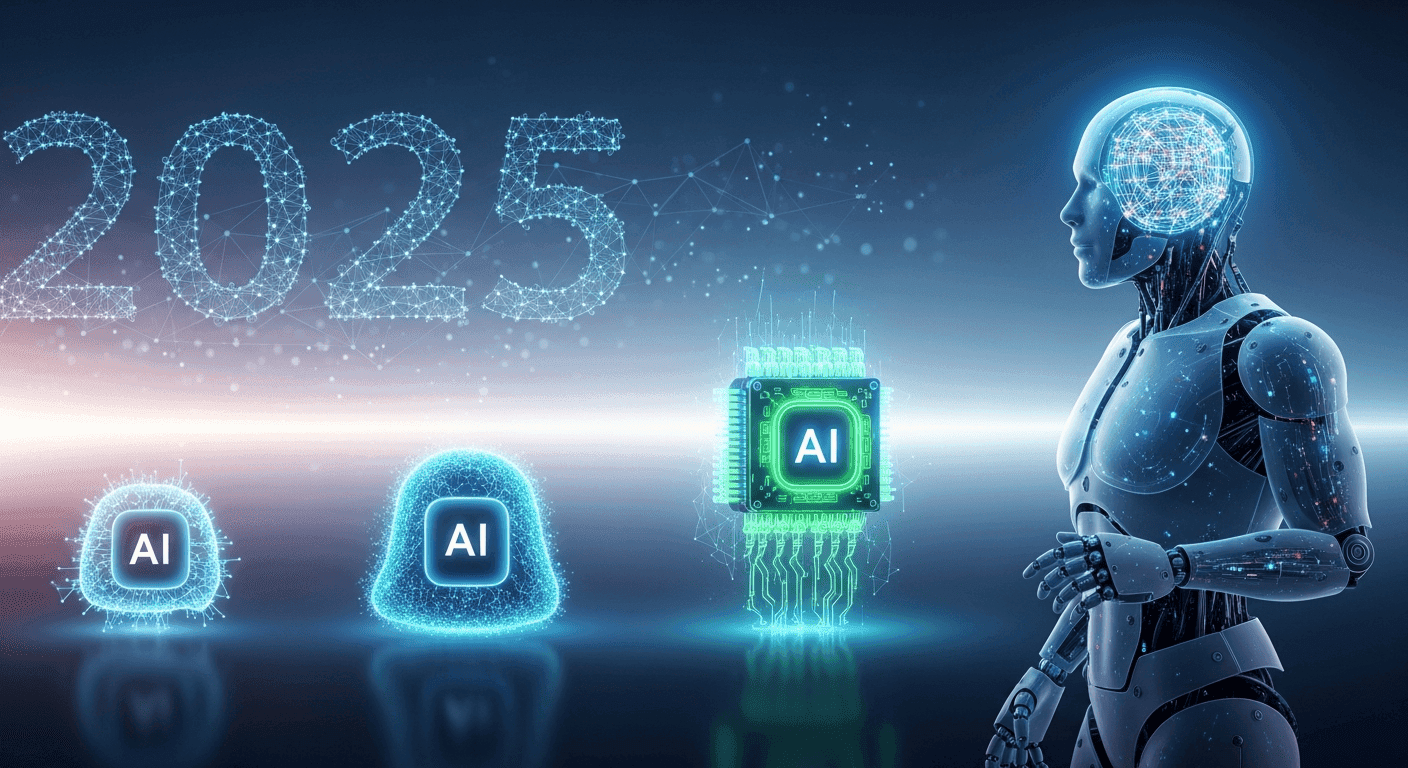

The evolution of AI agents has emerged as one of the most consequential technology shifts of 2025, signaling a move away from prompt-driven tools toward systems that can reason, plan, and act with minimal human input. These agentic systems are no longer confined to chat interfaces; they are being embedded across enterprise software, development pipelines, customer operations, and decision-making workflows. The change matters because it fundamentally alters how humans interact with machines—transforming AI from an assistant into a collaborator. Businesses, developers, and knowledge workers are all impacted as productivity gains accelerate, while governance, trust, and control become central concerns. This transition reflects a broader maturation of artificial intelligence, where value is measured not by model size alone, but by real-world autonomy and outcomes.
Background & Context
Early generations of AI tools focused on narrow tasks such as text generation, summarization, and question answering. These systems required constant human prompts and supervision, limiting their usefulness in complex workflows. Over time, advances in reasoning models, memory systems, and tool integration laid the groundwork for AI agents—software entities designed to pursue goals, break them into steps, and execute actions across multiple systems.
By late 2024, experimental agent frameworks demonstrated the ability to manage calendars, write and deploy code, analyze data, and coordinate with other agents. In 2025, these capabilities moved from prototypes into production environments, driven by enterprise demand for automation that goes beyond scripts and rule-based bots.
Expert Quotes / Voices
“AI agents represent a shift from reactive intelligence to proactive systems,” said Meera Khanna, Chief AI Architect at a global enterprise software firm. “The defining feature is not generation, but decision-making across time.”
Rohan Malhotra, an independent AI analyst, noted, “What’s different in 2025 is reliability. Agents can now maintain context, evaluate trade-offs, and recover from errors, which makes them viable for business-critical workflows.”
Market / Industry Comparisons
Traditional automation platforms relied heavily on predefined rules and brittle integrations. In contrast, AI agents adapt dynamically, making them more resilient in complex environments. Compared to earlier generative AI tools that focused on content output, agentic systems emphasize orchestration—coordinating APIs, databases, and applications.
This shift aligns with broader market trends favoring outcome-based software. Competitively, companies that embed agents deeply into their platforms are gaining an edge over those offering standalone AI features. The differentiation is moving from “AI-powered” labels to demonstrable autonomy and efficiency gains.
Implications & Why It Matters
For businesses, AI agents promise significant productivity improvements by reducing manual coordination and decision latency. Teams can offload routine planning, monitoring, and execution tasks, freeing humans to focus on strategy and creativity.
For developers, the rise of agents changes how software is built and maintained. Codebases increasingly interact with AI-driven components that can modify, test, and optimize systems in real time. At the same time, concerns around accountability, security, and alignment grow as agents gain more autonomy.
What’s Next
The next phase of AI agent evolution will focus on trust, governance, and interoperability. Expect stronger guardrails, audit trails, and human-in-the-loop controls. Multi-agent systems—where specialized agents collaborate—are also likely to become more common, enabling complex operations such as end-to-end business process management.
Pros and Cons
Pros
- Higher productivity through autonomous execution
- Reduced operational friction across tools and platforms
- Scalable decision-making support
Cons
- Increased risk if agents act on flawed assumptions
- Governance and compliance challenges
- Dependence on high-quality data and oversight
Our Take
AI agent evolution in 2025 marks a turning point where intelligence becomes operational, not just informational. The real disruption lies in how work is structured, not merely accelerated. Organizations that treat agents as strategic infrastructure—not novelty features—will shape the next decade of software and productivity.
Wrap-Up
As AI agents mature, they are redefining expectations around automation, autonomy, and collaboration. The 2025 AI landscape is less about smarter models and more about smarter systems—ones that act, adapt, and deliver measurable outcomes at scale.