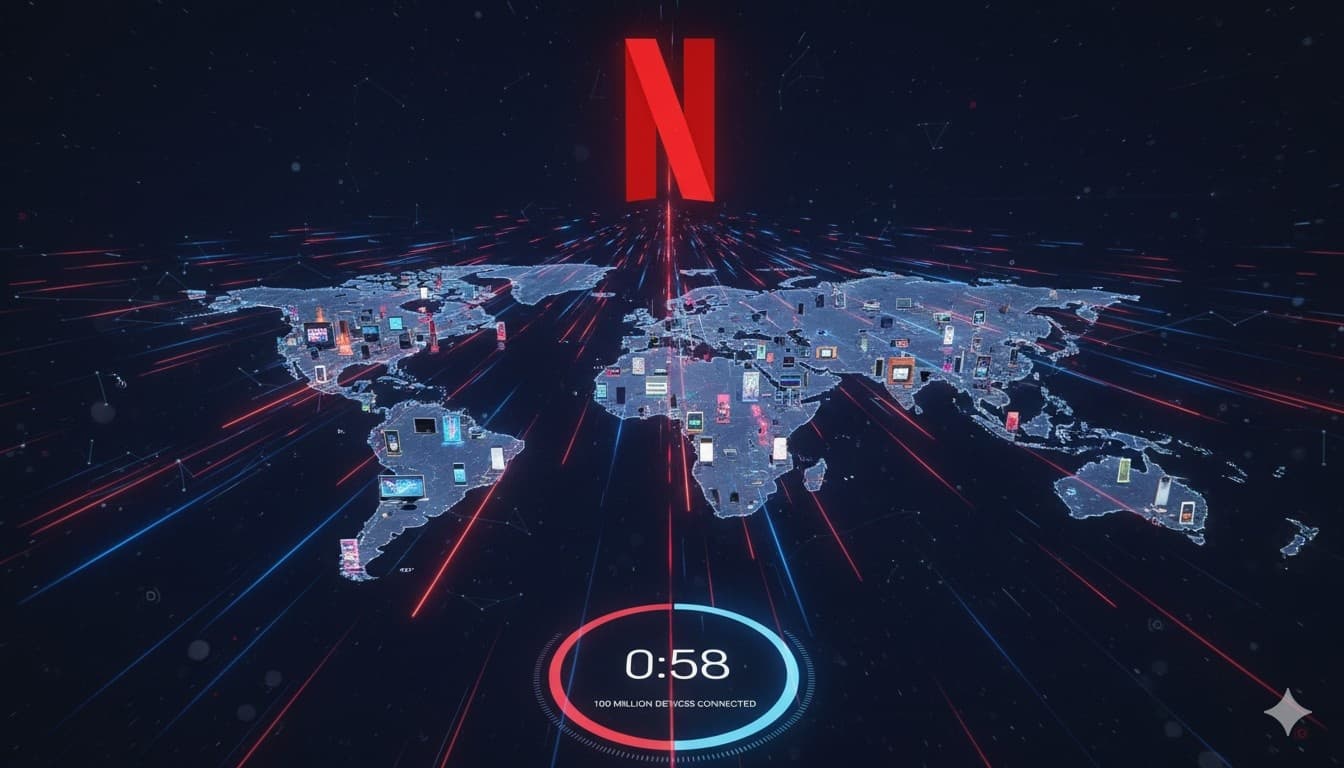

Netflix has announced a major performance breakthrough: its platform can now start streaming content on 100 million devices in under one minute. The milestone, revealed this week, highlights a massive upgrade to the company’s content delivery and device synchronization systems. For viewers, it promises smoother launches of major series—without the usual slowdowns or service congestion. For the streaming industry, the benchmark underscores Netflix’s continued dominance in performance engineering.
Background: The Rise of Ultra-Scale Streaming
Over the past decade, Netflix has invested heavily in global content delivery networks (CDNs), edge servers, and adaptive bitrate technologies. As streaming demand surged—especially during major series drops—the challenge shifted from offering high-quality streams to handling immense, simultaneous bursts of traffic. This new milestone builds on years of architectural evolution aimed at eliminating startup delays during peak events.
Key Developments: What Netflix Achieved
Netflix’s engineering team revealed that its optimized streaming engine can now initialize playback for 100 million devices within 60 seconds.
According to internal benchmarks, load spikes during global premieres—previously a stress point—now barely register as the system scales automatically across edge nodes.
Engineers attributed this breakthrough to three core improvements:
- Smarter Traffic Orchestration: Dynamic routing that pre-distributes metadata and streaming manifests before shows go live.
- Predictive Scaling: AI models forecast demand waves based on user behavior, enabling Netflix to warm up servers in key regions ahead of time.
- Edge-Optimized Caching: Popular titles are now cached at more endpoints, meaning fewer long-distance hops before playback begins.
Netflix engineers describe the experience as “press play, and it just works—instantly—even during a global premiere.”
Technical Explanation: How It Works
The system relies on a combination of predictive analytics and distributed caching.
Think of it like a city preparing for a massive concert: instead of waiting for crowds to arrive, organizers deploy staff, open extra gates, and stock supplies in advance.
Similarly, Netflix pre-loads the foundational elements of a title—thumbnails, subtitles, audio tracks, and initial segments—across global nodes.
When users hit Play, devices pull from nearby sources instead of remote servers, cutting startup times dramatically.
Implications: Why This Matters
For viewers, the benefits are immediate:
- Faster playback even on congested networks
- Fewer buffering issues during high-traffic events
- Increased reliability on older or low-powered devices
For Netflix, it strengthens its competitive advantage as streaming competition intensifies.
For the broader industry, it sets a new performance bar—one that other OTT platforms may need to match to keep viewer satisfaction high.
Challenges and Limitations
While impressive, the milestone isn’t universal. Playback speeds may still vary in:
- Rural regions with limited broadband
- Countries with older mobile infrastructure
- Networks impacted by congestion or throttling
Additionally, the system heavily depends on accurate demand prediction. Massive unforeseen spikes may still introduce delays.
Future Outlook
Netflix plans to extend the technology to support interactive content, live sports, and real-time events, where ultra-fast startup and synchronization are essential.
The company also hinted at upcoming innovations in AI-driven encoding and next-generation compression, which could further reduce bandwidth needs.
As streaming platforms race toward low-latency, high-reliability experiences, Netflix’s milestone could mark the beginning of a new era of hyper-optimized content delivery.
Conclusion
Netflix’s ability to stream to 100 million devices in under one minute shows what’s possible when engineering vision meets massive global scale. As demand for instant, seamless streaming grows, this breakthrough positions Netflix at the forefront of media technology—once again shaping the expectations for the entire industry.