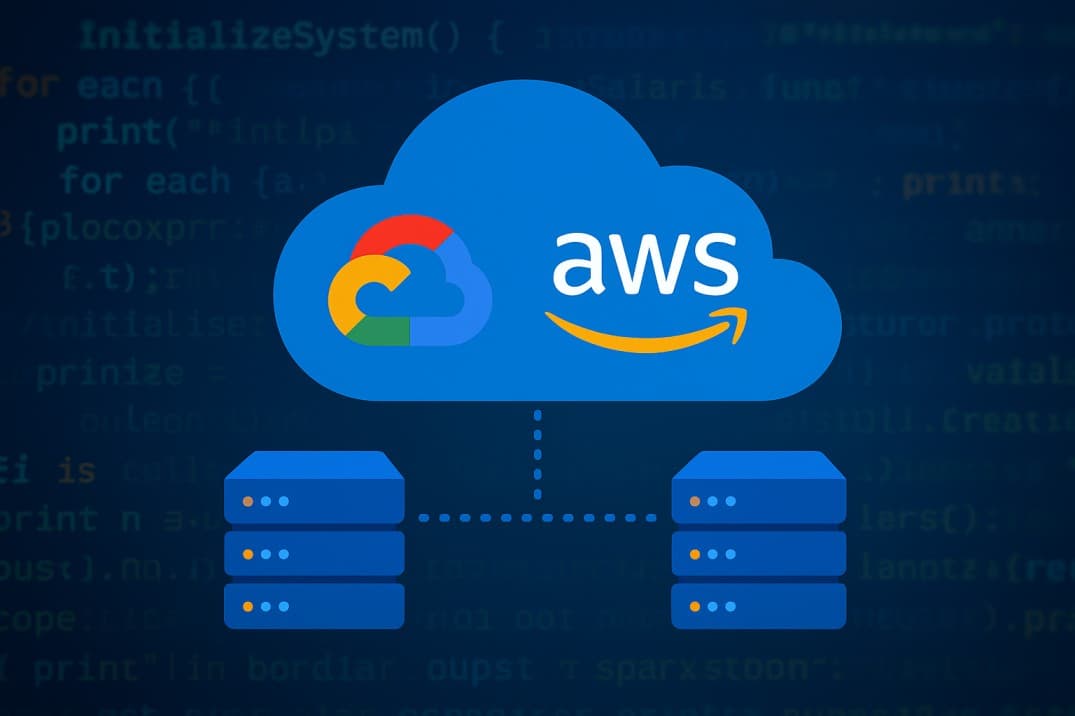

Google and Amazon have unveiled a new multicloud service that allows enterprises to deploy, manage, and scale applications across Google Cloud Platform (GCP) and Amazon Web Services (AWS) in a unified manner. The collaboration, rare for two of the world’s largest cloud rivals, reflects the growing demand for hybrid, flexible, and distributed cloud environments.
The service aims to reduce vendor lock-in, improve cross-cloud data mobility, and simplify application orchestration—key factors driving multicloud adoption in 2025.
Background: Why Multicloud Matters Now
Enterprises have increasingly adopted multicloud strategies to avoid dependency on a single vendor, improve resilience, and optimize costs. However, running workloads across two competing platforms like AWS and Google Cloud has historically required significant manual integration.
As AI workloads surge, data volumes explode, and global compliance standards tighten, organizations need cloud environments that are interoperable, secure, and easy to manage.
This new service directly targets those pain points.
Key Developments: What the New Service Offers
Unified Management Layer
The solution introduces a central dashboard where IT teams can monitor and manage applications running on both GCP and AWS. This includes deployment automation, performance insights, and unified billing.
Cross-Cloud Networking
A new secure networking layer enables faster, more reliable communication between workloads running on the two clouds—reducing latency for distributed applications, especially AI and analytics workloads.
Data Mobility Tools
Enterprises can seamlessly move or replicate datasets across AWS and Google Cloud without heavy data transfer complexities. This includes support for object storage interoperability and database syncing.
AI and ML Interoperability
The service allows customers to train models on Google’s AI stack while running inference or production workloads on AWS—or vice versa—depending on cost and performance needs.
Compliance and Security Integration
Both companies have aligned security standards and compliance frameworks, ensuring consistent policies across clouds.
Technical Explanation: How It Works
The multicloud service uses container orchestration, API compatibility layers, and cross-cloud connectors to allow workloads to communicate as if they were on a single platform.
Think of it like building a bridge between two separate islands—one built by Google, the other by Amazon—so businesses can move freely between them without rebuilding infrastructure from scratch.
Implications: Why This Matters
For Businesses:
- Lower risk of vendor lock-in
- Flexible workload placement
- Optimized cloud spending
- Stronger disaster-recovery strategies
For Developers:
- Unified development pipeline
- More powerful AI and data tools
- Greater freedom to choose best-fit services
For the Cloud Industry:
- Pressure on competitors like Microsoft
- Momentum toward open, interoperable cloud standards
Challenges and Limitations
Despite its promise, the collaboration comes with caveats:
- Pricing complexity may increase as workloads span two clouds.
- Performance may vary depending on the region and data transfer speed.
- Some proprietary services—especially in AI—may still work better natively.
- Deep technical expertise is required to leverage full benefits.
Enterprises will need skilled cloud architects and governance frameworks to implement the solution effectively.
Future Outlook
The partnership signals that the cloud market is shifting toward openness rather than isolated vendor ecosystems. Future updates may include:
- deeper Kubernetes-based integrations
- expanded AI/ML cross-cloud pipelines
- more automation for compliance and cost optimization
- partnerships involving additional cloud providers
As multicloud becomes the default strategy for global enterprises, Google and Amazon’s move may reshape how cloud services evolve in the next decade.
Conclusion
Google and Amazon’s multicloud service marks a pivotal moment in cloud computing—where collaboration replaces competition, and flexibility becomes the new norm. By enabling seamless cross-cloud operations, the two tech giants are offering enterprises a powerful toolkit to navigate an increasingly complex digital landscape.
In a world where data lives everywhere, this partnership may be the blueprint for the future of cloud.