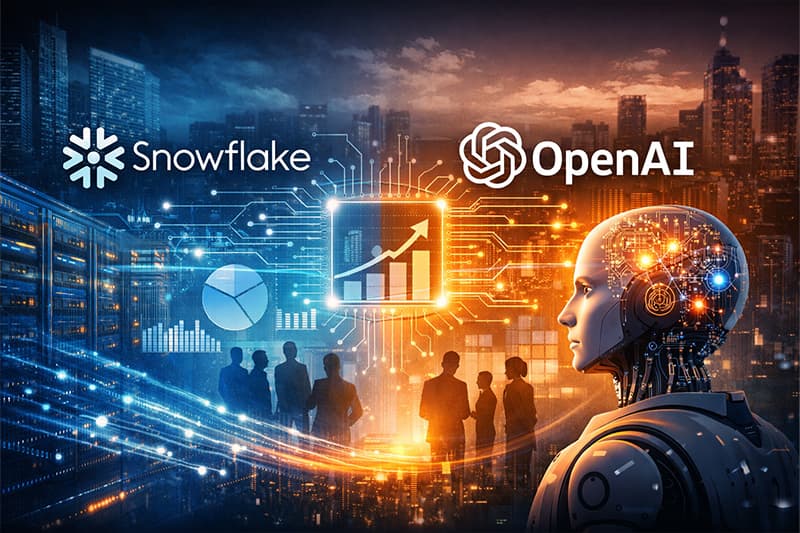

Snowflake’s recent deal with OpenAI highlights how quickly the enterprise AI race is heating up. The partnership brings OpenAI’s advanced models closer to Snowflake’s vast enterprise data ecosystem, aiming to make generative AI more practical for businesses. Announced as companies worldwide race to operationalize AI, the move underscores a clear message: data access and trust now matter as much as model performance.
Background
Over the past year, enterprises have moved from experimenting with generative AI to asking a tougher question—how do we deploy it securely on our own data? Cloud data platforms like Snowflake sit at the center of this shift, hosting massive volumes of structured and unstructured enterprise information. At the same time, foundation model providers such as OpenAI are looking beyond consumer tools toward large, recurring enterprise use cases.
This convergence has fueled a wave of partnerships across the industry, as vendors seek to shorten the path from AI promise to business value.
Key Developments
Snowflake’s deal with OpenAI allows customers to use OpenAI’s models directly with data stored in Snowflake’s Data Cloud. The focus is on enabling tasks like natural-language querying, automated analysis, and AI-powered applications without forcing companies to move sensitive data outside their existing environments.
Executives from both companies have framed the partnership as a way to reduce friction for enterprises adopting AI—combining trusted data infrastructure with state-of-the-art models. The collaboration also reflects growing demand from customers who want AI tools that work seamlessly with governed, enterprise-grade data.
Technical Explanation
Think of Snowflake as a highly organized digital warehouse for company data, and OpenAI as the “brain” capable of understanding and generating language. The partnership connects the two so businesses can ask questions in plain English—like “What drove last quarter’s revenue dip?”—and get meaningful answers drawn directly from their own data.
Crucially, this setup is designed to respect enterprise requirements around security, privacy, and compliance, which are often barriers to AI adoption.
Implications
The deal signals a broader trend: in enterprise AI, data gravity is winning. Companies don’t want to ship data to dozens of external tools; they want powerful AI to come to where their data already lives. For Snowflake, this strengthens its position as more than a data warehouse—it becomes an AI-ready platform. For OpenAI, it opens the door to deeper, stickier enterprise relationships.
For businesses, the benefit is speed. Integrations like this can cut months off AI deployment timelines and help teams move from pilots to production faster.
Challenges
Despite the promise, challenges remain. Integrating generative AI into core business workflows raises concerns around accuracy, hallucinations, and governance. Enterprises will still need strong oversight, human review, and clear policies to avoid costly mistakes. There’s also the risk of vendor lock-in as AI capabilities become tightly coupled with specific platforms.
Future Outlook
Expect more deals like this as the enterprise AI race intensifies. Data platforms, cloud providers, and model developers are likely to deepen collaborations—or even consolidate—to control more of the AI stack. Regulators may also take a closer look as generative AI becomes embedded in mission-critical systems.
Conclusion
Snowflake’s deal with OpenAI is less about a single partnership and more about a shift in strategy across enterprise tech. As AI moves from hype to utility, the winners will be those who can combine powerful models with trusted, well-governed data—at scale. That’s the real battleground of the enterprise AI race.