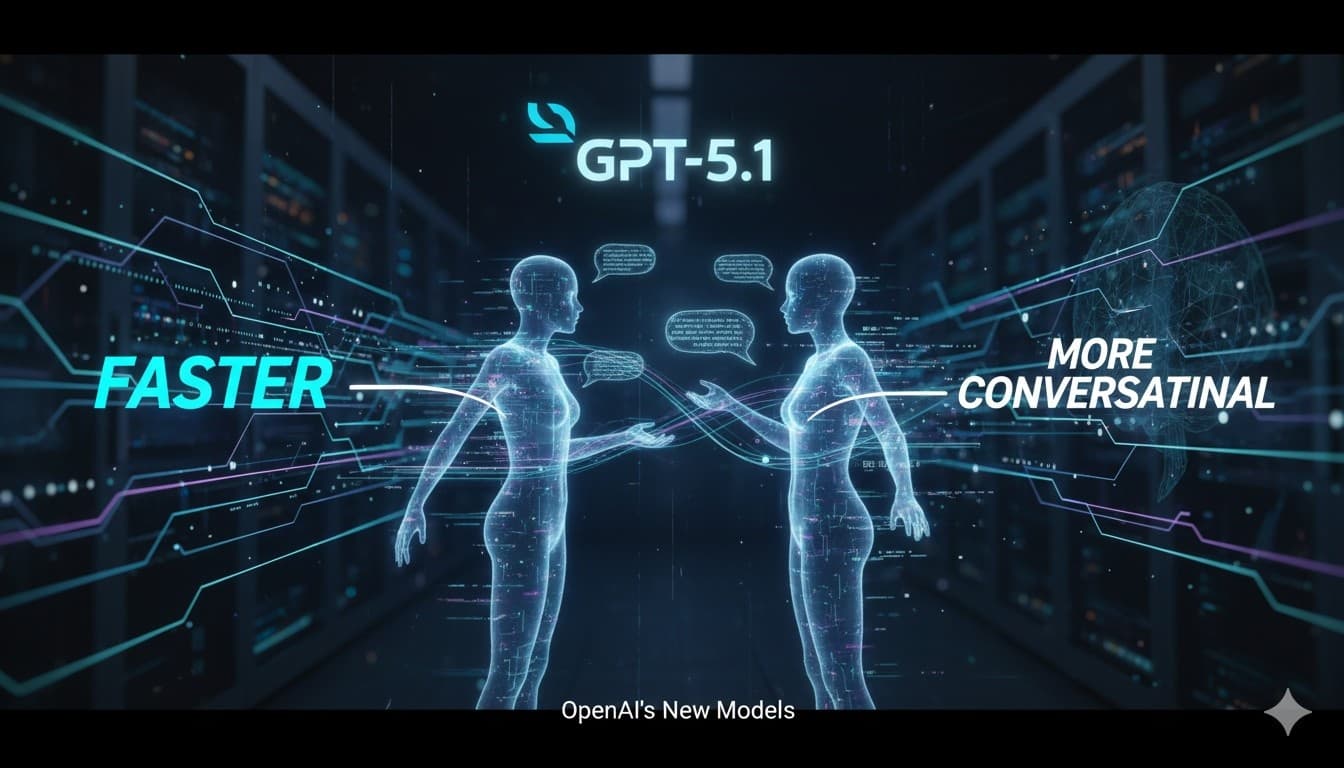

OpenAI has officially rolled out GPT-5.1, the latest upgrade in its flagship language model lineup, highlighting a significant leap in speed and conversational fluency. Announced this week, the update strengthens the company’s focus on real-time interactions and improved reasoning. With users increasingly relying on AI for productivity, support, and creativity, GPT-5.1 aims to deliver a more intuitive, responsive, and human-like experience.
Background / Context
OpenAI has steadily iterated on its generative models, with GPT-4, GPT-4.1, and GPT-5 laying the groundwork for major efficiency gains. The rise of multi-turn applications—AI assistants, customer service bots, coding copilots, and research tools—created demand for models that respond faster while maintaining accuracy. GPT-5.1 arrives as a direct answer to this industry shift toward natural, uninterrupted AI dialogues.
Key Developments / Details
According to OpenAI’s announcement, GPT-5.1 delivers noticeable speed improvements across a range of tasks, especially multi-round conversations and complex problem-solving. The model also enhances coherence, reduces interruptions and hallucinations, and offers smoother transitions between topics.
Researchers behind the model note that GPT-5.1 is designed to feel “more human” in interaction style—providing explanations that match the user’s tone and adjusting formality more intelligently. Testers reported fewer moments where the model paused, over-qualified its answers, or misinterpreted context from previous messages.
The model also introduces refined reasoning capabilities, enabling more consistent solutions for coding problems, math tasks, and long-form planning.
Technical Explanation
GPT-5.1 uses a hybrid training pipeline combining large-scale supervised learning with advanced reinforcement learning techniques that help the model evaluate its own responses. This leads to smoother multi-step reasoning—much like a person who silently drafts their thoughts before speaking.
The speed gains come from architectural optimizations that reduce token-generation latency. In simpler terms: the model can “think” and “speak” at the same time more efficiently, resulting in faster replies without sacrificing depth.
Implications
For everyday users, the upgrade means quicker and more natural conversations, especially during long sessions. Developers benefit from improved reliability in code assistance, faster API responses, and better context retention—useful for agents, automation tools, and enterprise workflows.
The broader industry may also see accelerated adoption of AI-powered productivity tools, real-time decision-making systems, and digital assistants that can handle more nuanced tasks.
Challenges / Limitations
Despite enhancements, GPT-5.1 is not free from limitations. AI experts caution that hallucinations, while reduced, still occur in complex reasoning tasks. The model’s more conversational tone may occasionally blur the line between confidence and accuracy, a concern that developers will need to monitor.
Additionally, the lack of transparency around full training data sources continues to be an ongoing discussion in the AI research community.
Future Outlook
OpenAI is expected to expand GPT-5.1 across more products and API tiers, potentially integrating real-time audio and multimodal capabilities more tightly. Researchers indicate future updates may focus on agentic behaviors—allowing models to plan, execute, and reflect autonomously.
If the current trajectory continues, GPT-5.1 could mark a pivotal step toward real-time, high-fidelity AI interactions that rival human assistance.
Conclusion
GPT-5.1 represents a meaningful upgrade that blends speed, stability, and conversational ease. While challenges remain, the model sets a strong foundation for the next wave of AI applications—ushering in a future where digital assistants feel more intuitive, responsive, and genuinely helpful.