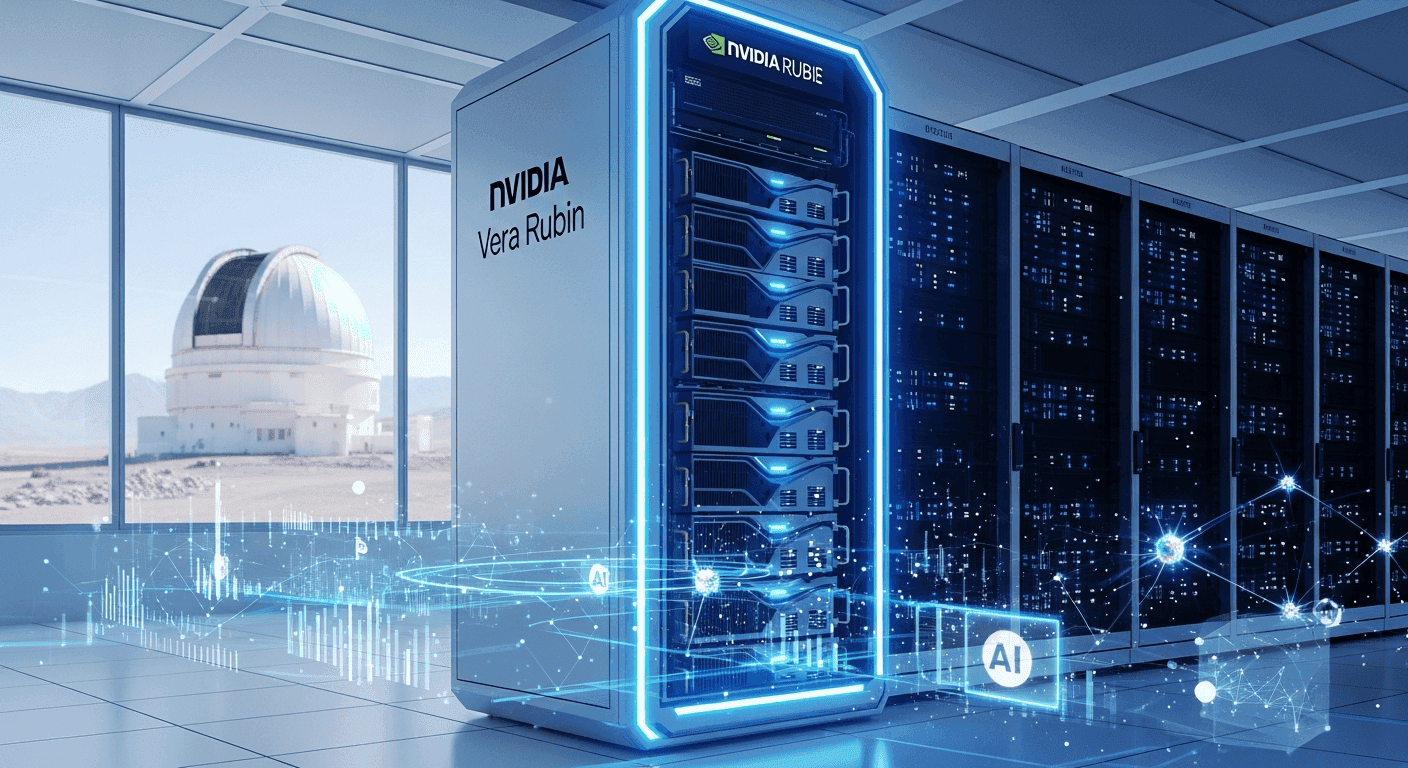

Nvidia has officially introduced the Vera Rubin platform, its newest AI computing foundation aimed at the next era of artificial intelligence. The launch is trending as the industry grapples with soaring compute demands from generative AI and large-scale models. Vera Rubin represents a shift toward higher efficiency and tighter hardware-software integration. Cloud providers, AI startups, and enterprise customers stand to be directly impacted. The platform reinforces Nvidia’s dominance in AI infrastructure while setting expectations for what comes after current-generation GPUs.
Background & Context
AI workloads have grown exponentially, pushing existing data center infrastructure to its limits. Training and running advanced models now require unprecedented levels of compute, power, and memory bandwidth. Nvidia’s previous platforms established the company as the backbone of modern AI systems.
The Vera Rubin platform arrives at a moment when efficiency, scalability, and cost control are becoming just as important as raw performance. The launch has fueled industry buzz as companies reassess long-term AI infrastructure strategies.
Key Facts / What Happened
The Vera Rubin platform introduces a new system-level approach to AI computing, combining next-generation processors, interconnects, and optimized software stacks. It is designed to handle both training and inference workloads more efficiently than previous architectures. The platform targets data centers, AI research labs, and large-scale commercial deployments. Nvidia positions Vera Rubin as a foundation for future AI models that are larger, more complex, and more autonomous.
Voices & Perspectives
Nvidia CEO Jensen Huang said, “Vera Rubin is built for an era where AI is not just an application, but the engine of every industry.”
An AI infrastructure analyst noted, “This platform reflects a shift from standalone GPUs to tightly integrated AI systems.”
A senior enterprise architect said, “Efficiency gains matter now more than peak performance. Platforms like Vera Rubin could reset cost expectations.”
Implications
For businesses, Vera Rubin could lower the barrier to deploying advanced AI by improving performance per watt and per dollar. Developers may gain faster iteration cycles and more predictable scaling. For the broader industry, the launch intensifies competition among AI chipmakers and accelerates the move toward specialized, purpose-built AI platforms.
What’s Next / Future Outlook
Nvidia is expected to roll out Vera Rubin across cloud partnerships and enterprise offerings over the coming quarters. Software updates and optimized AI frameworks will likely follow. The platform may also shape how future AI models are designed, favoring architectures that fully exploit system-level optimization.
Pros and Cons
Advantages
- Higher efficiency for large-scale AI workloads
- Strong hardware-software integration
- Designed for future AI model complexity
Limitations
- High initial cost for smaller organizations
- Best suited for large-scale deployments
Our Take
The Vera Rubin platform underscores Nvidia’s strategy of staying ahead not just in chips, but in complete AI systems. It reflects a maturing AI market where efficiency and scalability define leadership. For the ecosystem, this launch sets a new benchmark for what next-generation AI infrastructure should look like.
Wrap-Up
As AI continues to reshape industries, platforms like Vera Rubin highlight where the infrastructure race is headed. Nvidia’s latest move ensures it remains central to the conversation, keeping the Vera Rubin platform firmly in the “What’s Hot” spotlight.