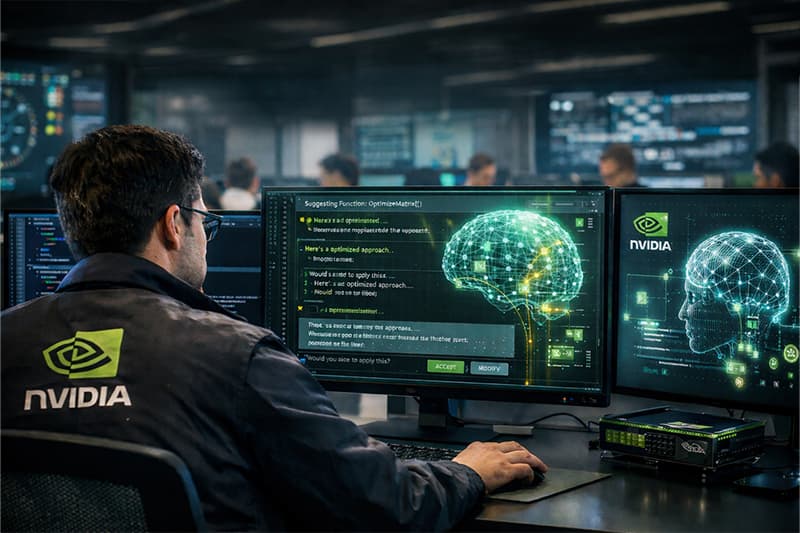

Nvidia has rolled out AI-powered coding tools to roughly 30,000 engineers across the company, marking a major step in its push to embed artificial intelligence into daily workflows. The initiative, announced as part of its broader internal AI strategy, aims to accelerate software development and improve productivity. The move reflects a growing trend among tech giants to operationalize generative AI beyond customer products. It also underscores Nvidia’s intent to “eat its own AI cooking” while scaling innovation from within.
Background
Nvidia’s rise as a central player in the AI boom has been fueled not just by its GPUs but by its expanding software ecosystem. As demand for AI infrastructure surged, the company invested heavily in developer platforms, AI frameworks, and enterprise solutions.
Internally, Nvidia has been experimenting with generative AI tools for code generation, debugging, and documentation over the past two years. Early pilot programs reportedly showed measurable productivity gains, prompting leadership to consider a company-wide rollout.
The broader industry context also played a role. Major technology firms have been equipping employees with AI copilots to streamline engineering work, reduce repetitive coding tasks, and shorten product cycles.
Key Developments
The newly expanded access provides tens of thousands of engineers with AI coding assistants integrated directly into their development environments. These tools can:
- Generate code snippets and functions
- Suggest bug fixes and optimizations
- Automate documentation
- Assist with testing and code reviews
Executives said the deployment is designed to free engineers from routine tasks so they can focus on higher-value design and architecture work.
Internal benchmarks shared by company leaders indicate that engineers using AI coding support completed certain programming tasks significantly faster than traditional workflows. Teams working on driver software, AI frameworks, and simulation platforms were among the early beneficiaries.
Technical Explanation
AI coding assistants function much like an autocomplete system on steroids.
Instead of predicting the next word, they analyze entire codebases, programming patterns, and developer intent. Using large language models trained on code, the tools can generate functional programs, refactor legacy code, or explain complex logic in plain language.
For example, an engineer writing GPU optimization routines can prompt the system to suggest performance improvements. The AI reviews memory usage, parallelization patterns, and prior implementations to recommend refinements.
Implications
Productivity and Speed
Company leaders believe widespread AI tooling could significantly compress development timelines. Faster iteration cycles may translate into quicker product releases and software updates.
Talent Leverage
By augmenting engineers with AI, Nvidia can scale output without proportionally increasing headcount—an efficiency play increasingly attractive in competitive tech markets.
Competitive Positioning
Using its own AI stack internally strengthens Nvidia’s enterprise credibility. Demonstrating real-world productivity gains can help sell AI platforms to corporate customers.
Challenges
Despite the promise, AI coding tools introduce risks:
- Code Accuracy: Generated code may contain subtle bugs or inefficiencies.
- Security Concerns: AI suggestions must be vetted to prevent vulnerabilities.
- Over-reliance: Engineers could become dependent on automation, potentially eroding deep coding expertise.
- IP and Compliance: Safeguarding proprietary code within AI systems remains critical.
To address these issues, Nvidia has implemented human review layers and secure model training environments.
Future Outlook
The company is expected to expand AI assistance beyond coding into chip design, simulation, and hardware verification workflows. Future iterations may integrate multimodal AI capable of interpreting schematics, performance graphs, and system telemetry.
Industry analysts predict Nvidia’s internal deployment could become a blueprint for other semiconductor and enterprise tech firms seeking productivity gains through generative AI.
Conclusion
By equipping 30,000 engineers with AI coding tools, Nvidia is institutionalizing artificial intelligence at the heart of its operations. The initiative highlights how generative AI is evolving from experimental tech to core enterprise infrastructure. If productivity gains hold, internal AI adoption may prove as transformative as the products Nvidia sells externally