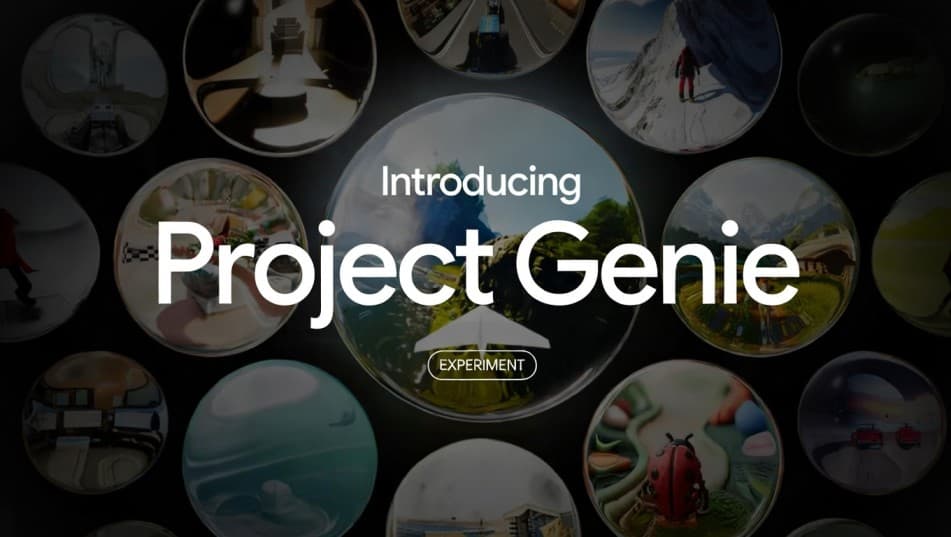

Google has launched Project Genie, an experimental research prototype that allows users to create and explore infinitely diverse interactive worlds using simple text prompts or images. Powered by the advanced Genie 3 world model from Google DeepMind, the tool rolled out on January 29, 2026, exclusively to Google AI Ultra subscribers in the United States who are 18 or older. This development marks a significant step in making real-time, photorealistic virtual environments accessible, potentially transforming how we think about creativity, gaming, and AI training.
Background
Google DeepMind has been advancing world models for years, starting with earlier versions like Genie 1 and Genie 2, which generated controllable 2D and 3D environments from videos and images. In August 2025, the team unveiled Genie 3 as a general-purpose world model capable of producing dynamic, interactive simulations with improved realism and consistency. Initially limited to trusted testers, Genie 3 demonstrated the potential for AI to simulate physics and respond to user actions in real time. Project Genie builds on this foundation, shifting from research demos to a user-facing prototype in Google Labs.
Key Developments
Announced in late January 2026, Project Genie lets subscribers "sketch" worlds through descriptive prompts—defining environments like forests, cities, or alien landscapes—and customize characters, perspectives (first-person, third-person, or isometric), and exploration modes (walking, flying, driving). Powered by Genie 3 for real-time generation, Nano Banana Pro for initial image sketches, and Gemini for enhancements, the tool generates photorealistic, navigable worlds at high frame rates. Users can explore, remix existing creations, and watch environments build dynamically around them. Access requires the premium Google AI Ultra subscription, priced at $250 per month, with plans for broader availability in the future.
Technical Explanation
At its core, Project Genie relies on a "world model"—an AI system trained to understand and predict how environments evolve. Think of it like an advanced video game engine, but instead of pre-built levels, the AI generates everything on the fly. You type a prompt like "a cyberpunk city at night where I fly as a drone," and Genie 3 simulates physics, lighting, and interactions consistently for short sessions (up to a few minutes at 720p resolution). As you move or act, the model predicts and renders the next frame instantly, creating the illusion of a living world.
Implications
This breakthrough could democratize world-building for creators, educators, and hobbyists, enabling rapid prototyping of virtual experiences without traditional coding or design tools. For the AI industry, it advances embodied agents by providing unlimited training simulations—crucial for robotics, autonomous vehicles, and general intelligence. It amplifies human creativity while hinting at future applications in entertainment, education, and professional simulation.
Challenges
As an early prototype, Project Genie has constraints: worlds maintain consistency for limited durations, realism varies, and character control can feel imprecise. It's restricted to U.S.-based AI Ultra subscribers, raising accessibility concerns. Google emphasizes safety measures, prohibiting harmful content and including safeguards for minors and personal images, but open-ended generation introduces risks around misuse or unintended biases in simulations.
Future Outlook
Google plans to expand access beyond the U.S. and refine the technology based on user feedback. As world models improve, we could see integrations with other AI tools, longer coherent sessions, higher resolutions, and applications in training advanced agents. This positions Google DeepMind as a leader in foundational AI for real-world understanding.
Conclusion
Project Genie turns imagination into explorable realities with unprecedented ease, signaling a new era where AI doesn't just generate images or text—it builds entire interactive universes. While still experimental, it's a compelling glimpse into how generative tools could reshape creativity and AI development. Keep an eye on this one; the worlds we build today may train the intelligences of tomorrow.