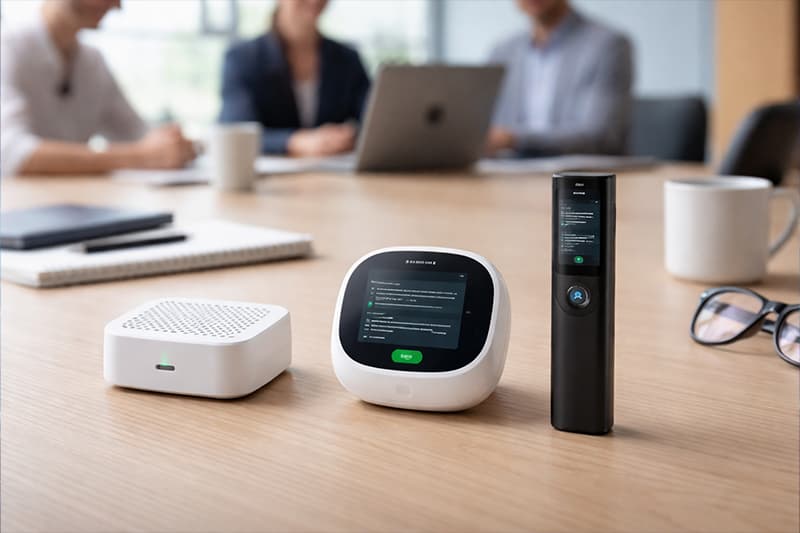

A new wave of AI notetaking devices is trying to solve one of modern work’s biggest pain points: keeping up with meetings. These compact gadgets automatically record conversations, transcribe speech in real time, and generate searchable summaries using on-device or cloud-based AI. Unlike phone apps, they’re purpose-built for meetings, interviews, and lectures, with better microphones and longer battery life. As hybrid work and back-to-back video calls become the norm, these devices promise fewer missed details and less manual note-taking. The big question is whether dedicated hardware can justify its place alongside smartphones and laptops.
Specs & Features
Most AI notetaking devices share a common feature set, though capabilities vary by brand and price. Core specs typically include multi-microphone arrays for 360-degree audio capture, onboard storage ranging from 16GB to 64GB, and AI-powered speech-to-text engines. Many support speaker identification, keyword tagging, and automatic summaries.
Compared to older digital voice recorders, these devices add real-time transcription and cloud syncing. Against competitors like smartphone apps or laptop-based tools, the advantage is consistency—always-on recording, better noise isolation, and fewer interruptions from notifications. Some models also integrate directly with popular meeting platforms and productivity tools.
Design & UX
Designs are generally minimalist and portable, often resembling small pucks, cards, or slim bars that sit discreetly on a table. Physical buttons for record and stop are common, reducing reliance on touchscreens. Companion apps handle transcript review, editing, and export.
The user experience is focused on simplicity: press record, attend the meeting, review notes later. While interfaces are usually clean, advanced features like editing summaries or correcting speaker labels often require switching to a phone or desktop app, which can interrupt workflow.
Performance & Hardware
Performance hinges on microphone quality and AI accuracy. Most devices use far-field microphones tuned to capture voices evenly across a room, with basic noise reduction for keyboards or background hum. Transcription accuracy is generally strong in quiet environments but can dip with heavy accents, overlapping speech, or noisy cafés.
Battery life typically ranges from 8 to 15 hours of continuous recording, enough for a full workday. Displays, if present, are small and functional, while speakers are minimal, as playback usually happens through the companion app. Durability is adequate for office use, though these aren’t rugged devices.
Price & Availability
AI notetaking devices usually launch in the mid to premium segment. Prices commonly start around ₹8,000–₹12,000 in India, with higher-end models crossing ₹20,000 depending on storage and AI features. Many brands also bundle or require subscription plans for advanced transcription, cloud storage, or multilingual support.
Availability varies by region, with most products initially sold online through official websites and major e-commerce platforms. Wider retail availability is expected as demand grows.
What’s Missing
The biggest trade-off is dependence on subscriptions—basic recording may be free, but full AI features often sit behind a paywall. Privacy is another concern, especially for sensitive meetings, as some devices rely on cloud processing. Additionally, smartphone apps still offer similar features at lower cost, making dedicated hardware feel redundant for casual users.
Verdict
AI notetaking devices are compelling tools for professionals who attend frequent meetings, interviews, or lectures. Their strengths lie in convenience, audio quality, and automation, though subscriptions and accuracy limitations remain pain points. For power users, they can save time and mental effort; for everyone else, apps may still suffice.
Wrap-Up
As AI transcription improves and on-device processing becomes more common, these gadgets could carve out a stable niche in productivity tech. Wider language support and lower subscription barriers will be key to mainstream adoption, and a full review will reveal whether they truly outperform software-only alternatives.