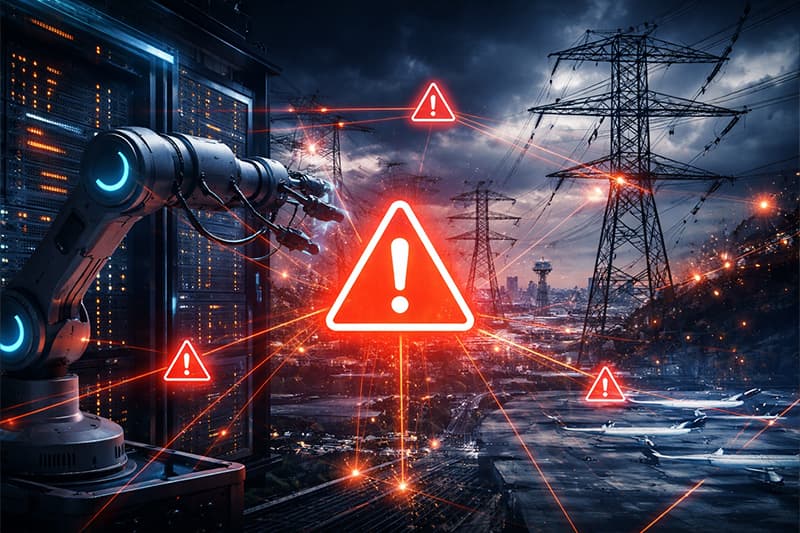

A misconfigured artificial intelligence system could shut down critical national infrastructure in a G20 country within the coming years, according to a new industry forecast. The warning highlights growing dependence on AI to manage power grids, transportation networks, and telecommunications. As governments accelerate automation, experts say configuration errors—not cyberattacks—may pose the most immediate risk. The projection underscores urgent calls for stronger oversight and fail-safe design.
Background
AI adoption across national infrastructure has surged over the past decade. Energy providers use machine learning to balance grid loads, transport authorities rely on AI for traffic orchestration, and telecom operators deploy automation to manage network demand in real time.
This shift has been driven by efficiency gains. AI systems can process millions of data points per second, optimizing distribution and predicting failures faster than human operators. However, the same autonomy introduces systemic risk when governance, testing, or configuration controls lag behind deployment speed.
Recent outages in automated industrial environments—though localized—have demonstrated how algorithmic errors can cascade across interconnected systems.
Key Developments
The forecast warns that a single misconfiguration—such as flawed training data, incorrect operational parameters, or an untested software update—could trigger nationwide disruption.
Analysts estimate the highest-risk sectors include:
- Electric power grids – AI load-balancing errors could cause cascading blackouts
- Rail and air traffic systems – Automated routing failures may halt transport
- Telecommunications networks – Self-optimizing outages could disable connectivity
- Water and utilities – Sensor misreads may interrupt supply distribution
Experts emphasize that the threat is not malicious AI but poorly implemented AI—systems deployed without rigorous simulation, redundancy, or human override safeguards.
One infrastructure risk specialist noted that automation layers are becoming so complex that “operators may not fully understand failure pathways until they occur in real time.”
Technical Explanation
A “misconfigured AI” refers to systems operating with flawed setup conditions rather than defective core algorithms.
Common causes include:
- Biased or incomplete training data – Leading to incorrect decision patterns
- Improper threshold settings – Triggering shutdowns or overload responses
- Integration conflicts – AI interacting unpredictably with legacy systems
- Autonomous feedback loops – Systems reinforcing their own errors
Think of it like autopilot in aviation: highly reliable, but if fed incorrect sensor data or miscalibrated settings, it can make precise yet dangerous decisions at machine speed.
In infrastructure, where milliseconds matter, such errors can propagate before humans can intervene.
Implications
The societal and economic stakes are enormous.
A nationwide infrastructure shutdown could:
- Disrupt hospitals and emergency services
- Halt financial transactions and markets
- Paralyze logistics and food supply chains
- Impact national defense readiness
Economists estimate that even a 24-hour grid failure in a major economy could result in tens of billions in losses.
Beyond economics, public trust in AI governance could erode, slowing digital transformation initiatives globally.
Challenges
Despite the warning, several constraints shape the risk outlook:
- Many infrastructure systems still use hybrid human-AI oversight
- Regulatory frameworks for safety testing are expanding
- Critical networks often include manual fallback controls
However, gaps remain:
- Uneven global safety standards
- Talent shortages in AI risk engineering
- Legacy infrastructure not designed for AI integration
Critics argue that organizations are prioritizing efficiency gains over resilience engineering.
Future Outlook
Governments and operators are expected to respond with stricter safeguards, including:
- Mandatory AI safety audits
- Simulation stress-testing before deployment
- “Human-in-the-loop” override mandates
- Infrastructure AI certification frameworks
Investment in explainable AI and monitoring systems is also projected to rise, enabling operators to understand algorithmic decisions in real time.
Insurance and national security agencies are already modeling AI failure scenarios alongside cyberwarfare risks.
Conclusion
As AI becomes the operational brain of national infrastructure, configuration risk is emerging as a critical vulnerability. The forecast serves less as alarmism and more as a governance wake-up call. Without robust safeguards, the efficiencies of automation could be overshadowed by systemic fragility—making AI safety as vital as AI innovation.