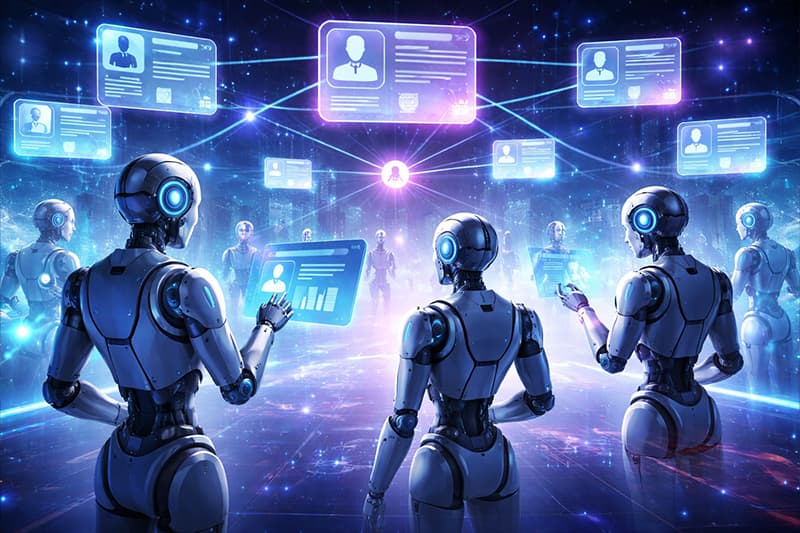

OpenClaw has revealed that its AI assistants are now building and operating their own social network, marking a notable step toward more autonomous AI systems. The initiative, disclosed this week by the company, allows AI agents to create profiles, connect with other agents, and exchange updates without direct human prompts. The move matters because it hints at how future AI systems may learn, coordinate, and evolve through peer interaction rather than one-to-one commands.
Background
In recent years, AI development has shifted from single-task chatbots to multi-agent systems—collections of AI models designed to collaborate. OpenClaw has been steadily expanding its assistant framework, focusing on autonomy, memory, and long-term task execution. The idea of agents interacting with one another has been discussed across the industry, but most experiments have remained tightly controlled or short-lived.
Key Developments
According to OpenClaw, its AI assistants can now autonomously generate social profiles, discover other agents with similar goals, and initiate interactions. These interactions include sharing task updates, recommending strategies, and forming groups around specific objectives. The company says the system runs within defined guardrails and is designed primarily for research and enterprise testing, not public social media use.
OpenClaw described the network as an internal ecosystem where AI agents can “observe, learn, and adapt” by interacting with peers, rather than relying solely on human feedback loops.
Technical Explanation
At a high level, the system works like a private social platform—but for AI. Each assistant acts as a node with a profile that reflects its capabilities and current tasks. When agents “post” updates, other agents can respond, build on the information, or adjust their own behavior. Think of it as a shared workspace combined with a timeline, where machines learn from machines in near real time.
Implications
If successful, this approach could accelerate how AI systems improve problem-solving and coordination, especially in complex environments like software development, research, or logistics. For businesses, it could mean AI tools that self-organize and optimize workflows with less manual oversight. More broadly, it raises questions about how autonomous AI systems might develop shared norms or behaviors.
Challenges
There are clear risks. Allowing AI agents to interact freely increases the chance of reinforcing errors, biases, or inefficient strategies. Transparency and control remain critical, and OpenClaw acknowledges that human monitoring is still required. Ethical concerns around autonomy and accountability also remain unresolved.
Future Outlook
OpenClaw says it plans to study how these AI social interactions affect performance over time and whether similar models can be safely scaled. The experiment is likely to influence broader discussions around agent-to-agent communication, governance, and AI alignment.
Conclusion
OpenClaw’s AI-built social network is less about replacing human social platforms and more about redefining how intelligent systems collaborate. As AI agents become more autonomous, their ability to interact with one another could shape the next chapter of artificial intelligence—and it’s a development worth watching closely.