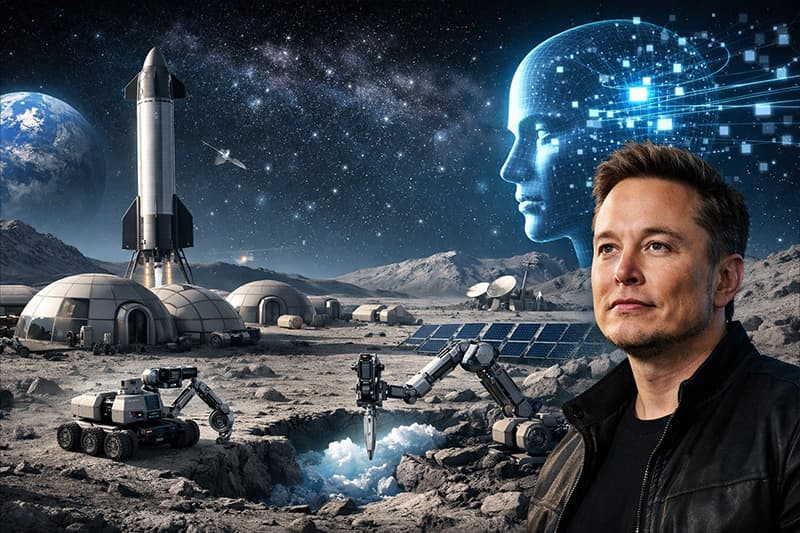

Elon Musk is charting a new strategic direction that brings his aerospace and artificial intelligence ambitions under a shared goal: building “Moonbase Alpha.” The initiative, revealed through recent internal discussions and public remarks, positions the Moon—not Mars—as the immediate proving ground for next-generation rockets and AI systems. The move signals a shift in priorities for SpaceX and xAI, tying their futures to a unified lunar vision. The stakes span technology leadership, national space agendas, and the commercialization of off-Earth infrastructure.
Background
For years, Musk’s long-term narrative centered on making humanity “multi-planetary,” with Mars as the ultimate destination. SpaceX’s Starship program was designed primarily with Mars colonization in mind, while xAI focused on building advanced artificial general intelligence systems on Earth.
However, mounting technical, financial, and geopolitical realities have reshaped near-term priorities. Lunar missions are gaining global momentum, with government agencies and private players accelerating Moon exploration due to its relative proximity, resource potential, and strategic value.
Against this backdrop, Musk began signaling the need for a nearer-term, operational vision—one capable of delivering tangible progress within a decade rather than generations.
Key Developments
The proposed “Moonbase Alpha” concept serves as that bridge.
According to people familiar with internal strategy conversations, the initiative would combine SpaceX’s heavy-lift launch capabilities with xAI’s data modeling, robotics, and autonomous systems to design and operate a permanent lunar installation.
Key pillars include:
- Autonomous construction systems powered by AI
- Lunar resource extraction, especially water ice
- On-site energy generation using solar arrays
- Data centers and compute hubs operating in low-temperature environments
Musk has framed the Moon as “the fastest path to proving we can live off Earth sustainably,” emphasizing iterative deployment over distant megaprojects.
Technical Explanation
In simple terms, Moonbase Alpha is envisioned as a self-improving lunar outpost.
AI would play multiple roles:
- Robotic builders trained on Earth would assemble habitats on the Moon
- Predictive maintenance systems would monitor life-support and hardware
- Autonomous mining rigs would extract regolith and ice
- Optimization models would manage power, oxygen, and logistics
Think of it as a “smart city”—but one operating in vacuum conditions, 384,000 km from Earth, where every watt and gram matters.
The Moon’s long nights and extreme cold also make it attractive for high-efficiency computing infrastructure, potentially useful for AI training workloads.
Implications
If realized, the initiative could reshape multiple industries:
Space commercialization
Permanent lunar infrastructure would create markets for transport, construction, telecom, and manufacturing.
AI deployment beyond Earth
Running advanced AI systems in space introduces new use cases—autonomous science, defense monitoring, and deep-space navigation.
Geopolitical positioning
Nations view lunar presence as strategic. A private-sector base could alter public-private power dynamics in space governance.
Human expansion
A functioning Moonbase would validate technologies required for Mars and beyond.
Challenges
Despite its ambition, the plan faces steep hurdles:
- Starship reliability and cadence must scale dramatically
- Lunar radiation exposure remains a major health risk
- Cost sustainability is unclear without government contracts
- AI autonomy in extreme environments is still experimental
Critics also argue that Mars colonization timelines could slip further if resources are redirected to lunar infrastructure.
Others question whether private entities should lead permanent off-world settlement.
Future Outlook
Near-term milestones tied to the vision reportedly include:
- Cargo-only Starship lunar missions
- AI-assisted robotic landing drills
- Prototype habitat deployment
- Power grid and comms network testing
If early phases succeed, human-tended missions could follow—transforming the Moon from a research destination into an industrial and computational hub.
The strategy may also position xAI as a leader in autonomous systems for space, a sector expected to grow alongside lunar logistics.
Conclusion
Moonbase Alpha represents more than a lunar base—it’s a convergence strategy. By aligning SpaceX’s launch dominance with xAI’s intelligence stack, Musk is reframing the Moon as the operational gateway to humanity’s space future. Whether it accelerates settlement—or stretches resources—will define the next decade of private spaceflight.