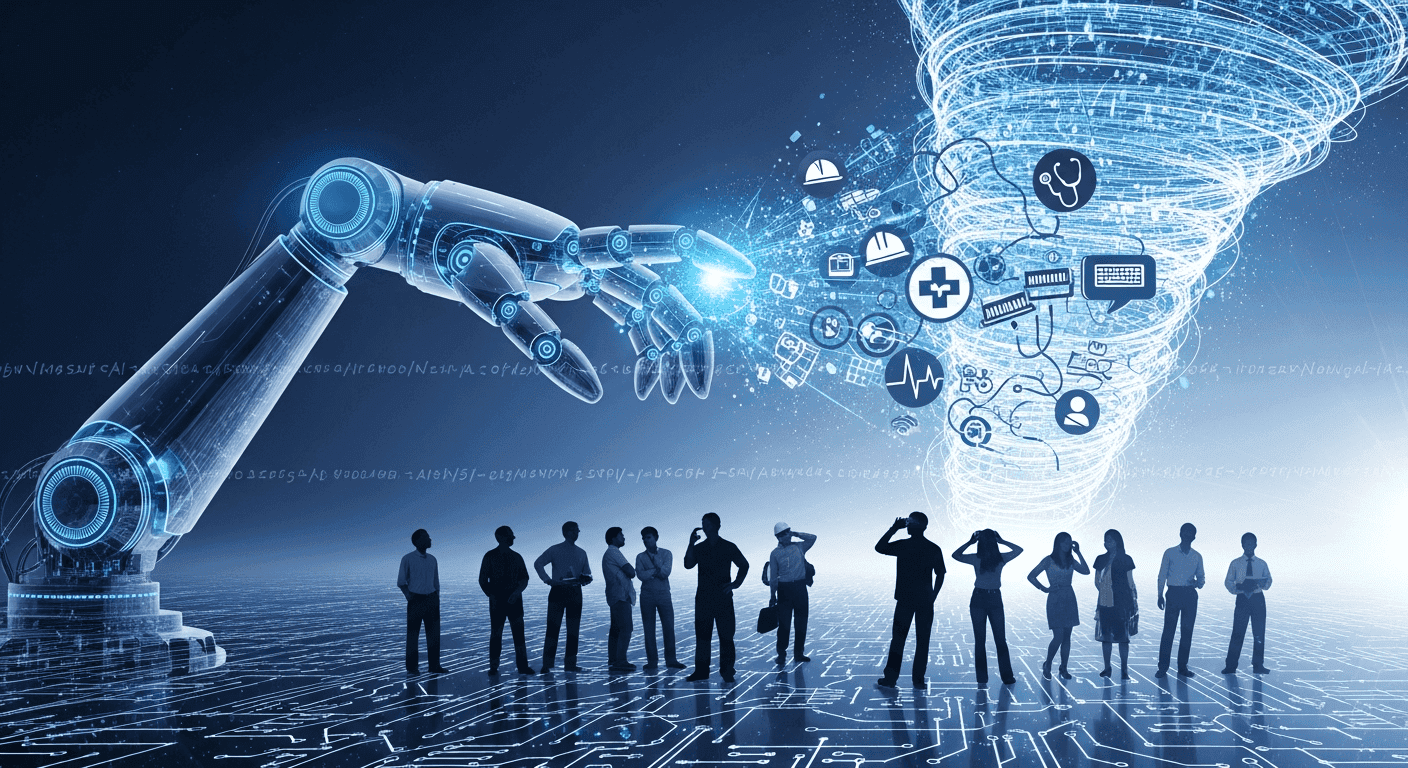

Artificial intelligence is reshaping labor markets worldwide as companies adopt automation, AI copilots, and data-driven workflows at unprecedented speed. Industries from manufacturing to software development are experiencing role shifts, new job creation, and varying levels of displacement. The growing influence of AI matters because it is not just changing what work is done — it is redefining how work gets done, who does it, and what skills the future workforce will need.
Background / Context
The rise of generative AI and machine learning accelerated digital transformation strategies that were already underway. Early automation targeted repetitive physical tasks, but modern AI systems now automate cognitive functions such as analysis, content generation, and decision support. As businesses push for efficiency and cost optimization, AI adoption has surged across operations, customer service, logistics, and creative industries. Workforce preparedness and policy discussions have intensified as job roles rapidly evolve.
Key Developments / Details
Recent industry evaluations show that AI-driven tools are increasingly embedded in everyday workflows — from AI copilots used by developers to automated systems managing supply chains. Executives describe AI as a “force multiplier” that enhances productivity rather than solely replacing workers.
Labor economist Priya Menon notes, “AI is not eliminating the need for human workers; it is eliminating the need for outdated skill sets. The fastest-growing jobs today did not exist even five years ago.”
Hiring trends reflect demand for skills in AI operations, prompt engineering, data governance, model oversight, and human–AI collaboration. Conversely, job categories involving predictable, rule-based tasks are under the highest automation pressure. Many companies are now designing hybrid roles where humans supervise or refine AI-generated outputs, especially in customer interactions, code reviews, and content pipelines.
Technical Explanation
AI systems analyze data, identify patterns, and make predictions that help automate decision-making. Unlike traditional software, generative AI can produce text, code, designs, or insights based on learned patterns. This shifts tasks from manual creation to strategic oversight. For example, instead of writing every line of code, developers may guide AI-generated code and focus on architecture, debugging, and security — similar to how pilots supervise autopilot systems.
Implications
AI’s influence varies across experience levels.
- Junior workers may find entry-level tasks automated, requiring stronger analytical and AI-assisted skills.
- Senior professionals often benefit from AI amplification, enabling faster decision-making and higher-impact leadership work.
- Businesses gain efficiency but face pressure to invest in training and responsible AI practices.
- Economies will see job redistribution rather than pure job loss, with growth in AI-aligned roles.
Ethically, concerns around fairness, transparency, and data privacy add complexity as AI enters more sensitive decision-making areas.
Challenges / Limitations
Despite its advantages, AI adoption faces several hurdles. Workforce reskilling gaps remain wide, with many employees unprepared for AI-intensive roles. Automation carries risk of job displacement in sectors with low digital readiness. Additionally, AI models may introduce biases or produce errors without proper human oversight. High implementation costs and regulatory uncertainties also slow adoption in traditional industries.
Future Outlook
AI’s role in job markets is expected to expand, prompting new policies around workforce transition, digital education, and safety standards. Governments and corporations are likely to emphasize talent development programs, human–AI collaboration frameworks, and ethical AI deployment. Over the next decade, job markets will continue shifting toward hybrid roles where creativity, critical thinking, and AI fluency become core requirements.
Conclusion / Summary
AI is reshaping job markets through both disruption and opportunity. While automation pressures certain roles, entirely new career paths are emerging around AI development, integration, and governance. The organizations that adapt early — and invest in upskilling their workforce — will lead the transition toward a more efficient, AI-augmented work era.
OUR TAKE
AI is redefining the job market in a way that rewards adaptability and continuous learning. The future workforce will not compete against AI but will work with it, leveraging automation to amplify human skills. The industries that succeed will be those that combine technological innovation with thoughtful workforce strategy, ensuring people remain at the center of progress.