

Software development is undergoing a cultural shift. On one side is vibe coding—a hands-on, exploratory approach driven by curiosity and deep understanding. On the other is AI-assisted coding, where editors generate solutions instantly. As AI adoption accelerates in 2024 and 2025, developers and teams are debating what they gain—and what they risk losing.
Background: Two Coding Mindsets Emerge
Traditionally, developers learned by writing, breaking, and fixing code. This process built intuition, debugging skills, and architectural thinking. With AI editors now handling much of the heavy lifting, a new workflow has emerged—one focused on speed and output.
Vibe coding represents a pushback against full automation. It prioritizes flow, experimentation, and personal engagement with the codebase, even if it takes longer.
What Is Vibe Coding?
Vibe coding is less about tools and more about mindset. Developers write code manually, explore different approaches, and stay deeply involved in problem-solving. Debugging is seen as a learning opportunity rather than a slowdown.
This approach often leads to stronger fundamentals, better intuition, and higher confidence—especially valuable for fresh developers building their core skills.
What Is AI-Assisted Coding?
AI-assisted coding relies on intelligent editors to generate code, suggest fixes, and refactor logic. The goal is efficiency: fewer keystrokes, faster releases, and reduced cognitive load.
For experienced developers, this can act like a productivity multiplier. For less experienced developers, however, it can quietly replace thinking with acceptance.
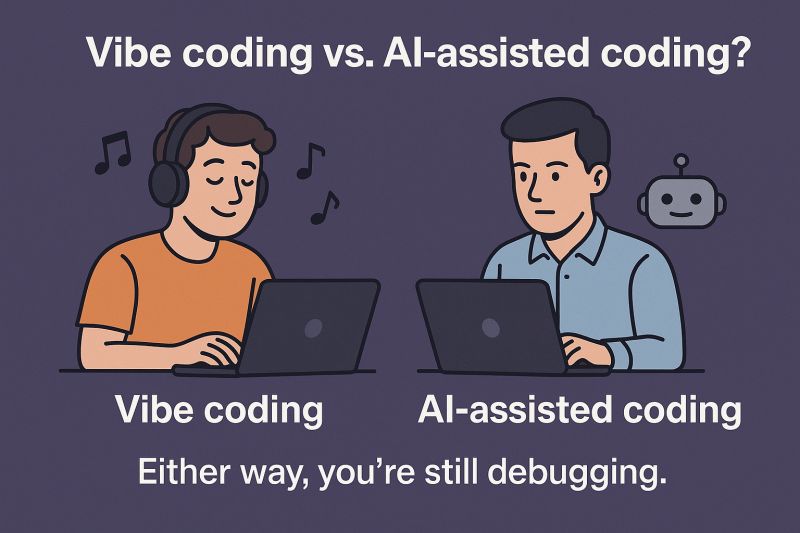
Key Differences at a Glance
- Speed: AI-assisted coding is significantly faster for routine tasks.
- Learning: Vibe coding encourages deep understanding; AI coding can skip it.
- Debugging: Manual coding builds strong debugging skills; AI-written code is often harder to trace.
- Creativity: Vibe coding fosters experimentation; AI tools tend to converge on common patterns.
Impact on Debugging and Self-Growth
One major concern with AI-assisted coding is debugging difficulty. When developers don’t fully understand the code, identifying root causes becomes harder and slower.
Self-growth also suffers if AI does most of the work. Developers may stop reading documentation, experimenting, or challenging themselves—key activities for long-term career progression.
Challenges and Trade-Offs
Vibe coding is time-consuming and may not suit tight deadlines. AI-assisted coding boosts productivity but risks shallow skill development if used blindly.
The real challenge is balance. Over-indexing on either approach can limit effectiveness—either by slowing delivery or weakening expertise.
Future Outlook: Hybrid Coding Culture
The future likely belongs to hybrid workflows. Developers may use AI for boilerplate and repetitive tasks, while reserving core logic, debugging, and design decisions for hands-on work.
Teams are also beginning to value learning metrics—code understanding, review quality, and debugging depth—alongside speed.
Conclusion
Vibe coding and AI-assisted coding are not enemies—they are complements. The danger lies in letting AI replace thinking entirely. Developers who stay curious, question AI output, and keep coding “in the vibe” are more likely to grow, adapt, and lead in an AI-driven future.